
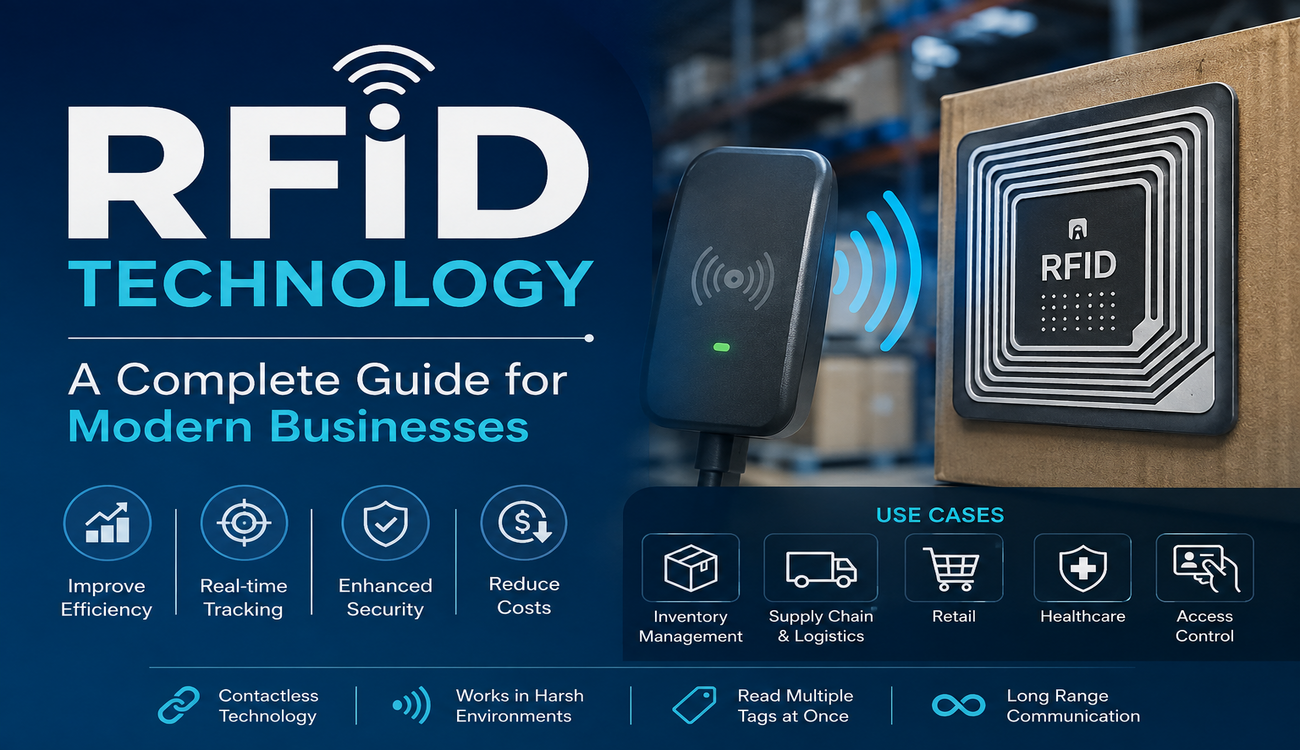
Businesses today are constantly looking for better ways to track assets, manage inventory, improve operations, and reduce manual work. This is where RFID Technology has become an important solution for organizations across industries. Unlike traditional barcode systems that require direct scanning, RFID enables businesses to identify and track objects using radio waves, making data collection faster, more automated, and more reliable.
From warehouses and manufacturing facilities to hospitals, retail stores, logistics operations, and corporate offices, RFID Technology helps organizations gain better visibility into their physical assets and products. As businesses continue adopting automation and connected systems, understanding how RFID works, where it can be used, and what benefits it offers has become increasingly important.
What Is RFID Technology?
RFID Technology, or Radio Frequency Identification Technology, is a wireless identification and tracking technology that uses radio waves to automatically identify objects, products, equipment, or other physical items. An RFID system generally works through RFID tags, RFID readers, antennas, and software that collects and processes the information captured from the tags.
An RFID tag contains electronically stored information that can be associated with a specific asset or product. When the tag comes within the communication range of an RFID reader, the reader captures the information and sends it to connected software. This allows businesses to identify and monitor items without requiring employees to manually enter information or scan every item individually.
One of the biggest differences between RFID and traditional barcode technology is the way information is captured. Barcodes normally require line-of-sight scanning, while RFID tags can often be detected without being directly visible to the reader. This makes RFID particularly useful in environments where businesses need to track large quantities of items quickly.
How Does RFID Technology Work?
The working process of RFID Technology begins when an RFID reader sends a radio frequency signal through its antenna. When an RFID tag enters the reader’s communication range, the tag responds by transmitting its stored information back to the reader.
The reader then captures the tag data and transfers it to an RFID software platform or connected business system. Depending on the implementation, the information can be integrated with inventory management software, ERP platforms, warehouse management systems, asset management applications, or other enterprise systems.
RFID Tags
RFID tags are attached to or embedded within products, equipment, containers, identification cards, or other physical objects. A tag typically contains a microchip and antenna that allow it to communicate with an RFID reader.
Some RFID tags are passive, meaning they do not have their own internal power source and receive energy from the reader’s signal. Active RFID tags contain a battery and can generally communicate over longer distances. There are also semi-passive tags that use a battery for certain functions while relying on the reader for communication.
RFID Readers and Antennas
RFID readers are responsible for communicating with RFID tags and collecting their information. Antennas transmit and receive radio frequency signals between the reader and the tags.
The type and placement of RFID readers and antennas depend on the business environment. For example, fixed readers can be installed at warehouse entrances, production lines, or checkpoints, while handheld RFID readers can be used by employees for mobile inventory and asset tracking.
RFID Software
The software layer plays a critical role in turning raw RFID data into useful business information. RFID software can collect tag information, maintain records, provide real-time visibility, and connect RFID data with existing enterprise applications.
A properly designed RFID solution can help organizations move beyond simple identification toward automated tracking, analytics, alerts, reporting, and operational decision-making.
Types of RFID Technology
RFID Technology can be categorized based on frequency, communication range, tag design, and application requirements. The most common frequency categories include low frequency, high frequency, and ultra-high frequency RFID.
Low-frequency RFID generally operates over shorter distances and is often used for applications such as animal identification, access control, and specialized tracking environments. High-frequency RFID provides a broader range of applications, including smart cards, library systems, payment-related applications, and access management.
Ultra-high-frequency RFID is widely used for inventory, logistics, warehouse, supply chain, and asset tracking applications because it can provide longer read ranges and support the rapid identification of multiple tags.
Choosing the appropriate RFID type depends on factors such as required reading distance, environmental conditions, tag material, item size, data requirements, and business objectives.
RFID Technology vs Barcode Technology
RFID and barcode systems are both used to identify and track products and assets, but they operate differently. Barcode systems use optical scanning and normally require a direct line of sight between the scanner and the barcode. RFID systems communicate wirelessly, allowing tags to be identified without directly pointing a scanner at each individual item.
RFID can also support the reading of multiple tags simultaneously, which can significantly improve inventory counting and tracking processes. Barcode systems, on the other hand, are generally simpler and less expensive for organizations with basic identification requirements.
The right choice depends on the business use case. For simple product identification, barcode technology may remain practical. For organizations requiring automated tracking, faster inventory processes, improved visibility, and reduced manual intervention, RFID Technology can provide significant advantages.
Benefits of RFID Technology for Modern Businesses
Faster Inventory Management
One of the major benefits of RFID Technology is faster inventory management. Employees can identify multiple tagged items without manually scanning each barcode. This can reduce the time required for stock counting and improve the efficiency of warehouse operations.
Businesses can use RFID to maintain more accurate inventory records and identify discrepancies between physical stock and system records. Better inventory visibility can also support improved purchasing, replenishment, and order fulfillment.
Improved Asset Tracking
Organizations often manage thousands of physical assets, including equipment, tools, IT devices, medical equipment, containers, and machinery. Tracking these assets manually can be time-consuming and can result in misplaced or missing items.
RFID enables businesses to associate unique identification information with individual assets and monitor their movement through different locations. This provides organizations with greater visibility into where assets are located and how they are being used.
Reduced Manual Work
Manual data collection can consume significant employee time and may introduce errors. RFID Technology can automate many identification and tracking activities, reducing the need for repetitive scanning and manual record keeping.
By connecting RFID systems with enterprise software, businesses can create automated workflows that capture information and update relevant systems with minimal human intervention.
Better Supply Chain Visibility
Supply chains involve multiple stages, including manufacturing, warehousing, transportation, distribution, and delivery. Lack of visibility at any stage can create delays and inventory problems.
RFID Technology can provide organizations with better visibility into the movement of products and containers throughout the supply chain. This can help businesses identify bottlenecks, improve traceability, and respond more quickly to operational issues.
RFID Technology Use Cases Across Industries
RFID in Manufacturing
Manufacturers can use RFID Technology to track raw materials, work-in-progress items, finished products, tools, and production equipment. RFID can provide visibility into the movement of materials between different production stages and help organizations improve production planning.
When integrated with manufacturing systems, RFID data can also support automated production workflows and improve traceability.
RFID in Warehousing and Logistics
Warehouses handle large quantities of inventory that must be received, stored, picked, packed, and dispatched. RFID can automate identification during these processes and improve inventory accuracy.
Logistics companies can also use RFID to track containers, pallets, shipments, and reusable transport equipment. This helps improve operational visibility while reducing manual tracking activities.
RFID in Healthcare
Hospitals and healthcare organizations manage expensive medical equipment, supplies, medicines, and other critical assets. RFID Technology can help healthcare facilities monitor equipment locations, manage inventory, and improve asset utilization.
By knowing where equipment is located, staff can spend less time searching for essential resources and more time focusing on operational and patient-related responsibilities.
RFID in Retail
Retailers can use RFID to track products from distribution centers to stores and sales areas. Better item-level visibility can help retailers improve inventory accuracy, reduce stock discrepancies, and support more efficient replenishment.
RFID can also support faster stocktaking and help businesses understand product movement across their retail operations.
RFID in IT Asset Management
Organizations manage large numbers of laptops, servers, networking equipment, monitors, and other IT assets. RFID can help companies maintain accurate records of these assets and monitor their movement across offices, storage areas, and other facilities.
This can improve asset accountability and make audits and asset verification more efficient.
Challenges of Implementing RFID Technology
Although RFID Technology offers significant benefits, implementation requires careful planning. RFID performance can be affected by environmental factors, physical obstructions, metal surfaces, liquids, interference, and the positioning of readers and antennas.
Another important consideration is the cost of implementation. Businesses need to evaluate the cost of tags, readers, antennas, software, infrastructure, integration, and ongoing maintenance against the expected operational benefits.
Data integration is another critical factor. RFID systems generate large amounts of identification data, and organizations need appropriate software and system integration to convert that data into meaningful business information.
Successful implementation therefore requires a clear understanding of the business process, suitable hardware selection, proper system configuration, testing, and employee training.
How Businesses Can Implement RFID Technology Successfully
Businesses should begin by identifying a specific operational problem that RFID can solve rather than deploying the technology without a defined objective. Inventory accuracy, asset visibility, supply chain tracking, and automated identification are common starting points.
The next step is selecting suitable RFID tags, readers, antennas, and software based on the operating environment. Organizations should conduct pilot testing before expanding the solution across an entire facility or business operation.
Integration should also be considered from the beginning. RFID data becomes more valuable when it can communicate with existing ERP, WMS, inventory management, asset management, or other enterprise systems.
Choosing the Right RFID Solution
The right RFID solution depends on the organization’s operational requirements. Businesses should evaluate read distance, tag durability, environmental conditions, tracking accuracy, scalability, integration requirements, and total implementation cost.
A scalable RFID architecture can allow organizations to begin with one use case and gradually expand into other departments or facilities as the benefits become measurable.
The Future of RFID Technology
The future of RFID Technology is closely connected with automation, IoT, artificial intelligence, cloud platforms, and real-time analytics. RFID-generated data can increasingly be combined with other technologies to create connected business environments.
For example, RFID data combined with IoT sensors can provide organizations with broader visibility into asset location and environmental conditions. Integration with analytics and AI can help businesses identify patterns, predict operational issues, and improve decision-making.
As organizations continue moving toward connected and data-driven operations, RFID is expected to remain an important technology for physical asset identification and tracking.
Conclusion
RFID Technology has evolved from a specialized identification solution into an important component of modern business operations. Its ability to automatically identify and track physical objects can help organizations improve inventory accuracy, asset visibility, supply chain efficiency, and operational productivity.
While successful implementation requires appropriate hardware, software, integration, and planning, the potential benefits make RFID a valuable technology for businesses seeking greater automation and real-time visibility. As RFID continues to integrate with IoT, cloud platforms, analytics, and AI, its role in creating smarter and more connected business operations is likely to become even more significant.
Frequently Asked Questions
Q1. What is RFID Technology?
RFID Technology uses radio waves to identify and track objects, products, assets, or equipment through RFID tags and readers without requiring direct line-of-sight scanning.
Q2. How does RFID Technology work?
RFID Technology works by using an RFID reader to send radio signals to a tag. The tag responds with its stored information, which the reader captures and sends to connected software for processing.
Q3. What are the main benefits of RFID Technology for businesses?
RFID Technology can improve inventory accuracy, automate asset tracking, reduce manual work, increase supply chain visibility, and help businesses manage physical assets more efficiently.
Q4. What industries use RFID Technology?
RFID Technology is widely used in manufacturing, retail, healthcare, logistics, warehousing, transportation, IT asset management, and supply chain operations.
Q5. Is RFID Technology better than barcode systems?
RFID Technology can provide faster and more automated identification because multiple tags can often be read without direct line of sight. However, barcode systems may be more suitable for simpler and lower-cost tracking requirements.