
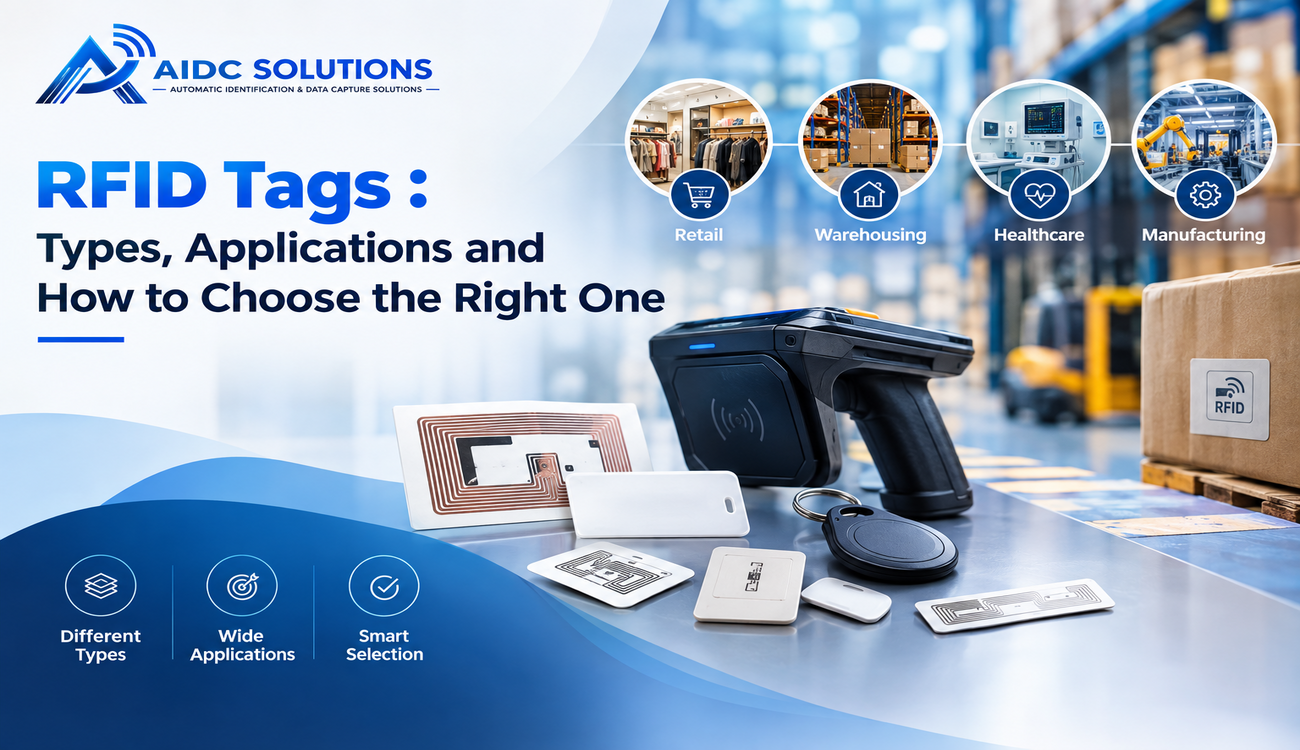
RFID Tags are an essential part of modern identification and tracking systems, helping businesses improve inventory accuracy, streamline operations, and monitor assets in real time. Radio Frequency Identification (RFID) technology uses radio waves to identify and track objects without requiring direct physical contact or a clear line of sight. From retail stores and warehouses to healthcare facilities and manufacturing plants, this technology supports faster data collection and more efficient business processes.
As businesses handle growing volumes of products, equipment, and inventory, traditional tracking methods such as manual data entry and barcode scanning can become time-consuming. RFID technology offers an alternative by enabling multiple tagged items to be identified automatically within a suitable reading range. However, selecting the right solution requires an understanding of different tag types, their applications, operating frequencies, and environmental requirements.
Understanding how RFID Tags work and where they deliver the most value helps organizations choose a solution that matches their operational needs, improves visibility, and supports long-term business efficiency.
What Are RFID Tags?
RFID Tags are small electronic devices that store identification information and communicate with RFID readers through radio waves. A typical tag consists of a microchip that stores data and an antenna that transmits or receives radio frequency signals. Depending on the design, tags can be attached to products, embedded in equipment, placed inside labels, or integrated into durable industrial materials.
When an RFID reader sends out a radio signal, a compatible tag responds by transmitting its stored information. The reader captures this information and transfers it to a connected software system, where the data can be processed for inventory management, asset tracking, access control, or other business operations.
Unlike traditional barcodes, RFID systems can identify multiple tagged objects simultaneously, depending on the reader, tag design, operating environment, and system configuration. This capability makes RFID particularly useful in environments where organizations need to track large quantities of items quickly and accurately.
How RFID Technology Works
RFID technology operates through communication between a tag, a reader, and a data processing system. Each component plays an important role in collecting and managing identification information.
RFID Tag and Antenna
The tag stores a unique identifier or other relevant information. Its antenna receives signals from the reader and enables communication. The tag’s design, size, material, and antenna configuration influence its reading performance.
RFID Reader and Antenna
The reader generates radio frequency signals and receives responses from compatible tags. Depending on the application, readers may be handheld devices, fixed installations, or integrated systems used at entry points, conveyor belts, warehouses, and production lines.
Software and Data Processing
The collected information is transferred to inventory software, enterprise resource planning systems, warehouse management platforms, or other business applications. These systems help organizations monitor stock movements, locate assets, maintain records, and generate operational reports.
When these components work together, businesses can automate identification processes, reduce repetitive manual tasks, and improve the availability of accurate operational data.
Types of RFID Tags
Different applications require different tag designs, communication methods, and performance characteristics. Understanding the main categories helps businesses identify the most appropriate technology for their requirements.
Passive RFID Tags
Passive tags do not contain an internal battery. Instead, they obtain the energy needed for communication from the radio frequency signal transmitted by the reader. Their relatively low cost, compact design, and minimal maintenance requirements make them suitable for applications involving large quantities of tagged items.
These tags are widely used in retail inventory, product labeling, library systems, warehouse operations, and supply chain tracking. However, their performance depends on the reader’s power, operating frequency, antenna design, and surrounding materials.
Active RFID Tags
Active tags contain an internal battery that powers their communication capabilities. They generally offer longer reading ranges than passive tags and can support applications that require continuous monitoring or frequent identification over larger areas.
Businesses use active technology for tracking high-value equipment, industrial assets, vehicles, and certain types of returnable transport containers. Although these tags can provide extended coverage, their higher cost, larger size, and battery maintenance requirements should be considered during implementation.
Battery-Assisted Passive RFID Tags
Battery-assisted passive tags use an internal battery to power the chip or onboard sensors while relying on a reader’s signal for communication. They can offer improved sensitivity or additional monitoring capabilities compared with conventional passive designs.
These tags are useful in specialized applications where environmental conditions, sensor integration, or particular reading requirements make standard passive tags less suitable. Their performance and cost depend on the specific design and intended application.
RFID Frequency Types and Their Differences
RFID systems operate across different frequency ranges, and each range offers distinct advantages. Choosing the appropriate frequency is important because it affects reading distance, speed, material compatibility, and performance in different environments.
Low-Frequency RFID
Low-frequency RFID typically operates at 125–134.2 kHz. It generally provides a short reading range and can perform reliably in applications where proximity identification is required. It is commonly used for animal identification, certain access control systems, and industrial identification.
High-Frequency RFID
High-frequency RFID generally operates at 13.56 MHz. It supports applications such as contactless cards, library systems, ticketing, and selected healthcare identification processes. Near-field communication, or NFC, operates at 13.56 MHz and is a related technology used for short-range interactions between compatible devices.
Ultra-High-Frequency RFID
Ultra-high-frequency RFID commonly operates around 860–960 MHz, with permitted frequencies varying by region. It supports relatively longer reading distances and fast identification of multiple items, making it suitable for retail inventory, logistics, warehouse management, and supply chain operations.
However, UHF performance can be affected by liquids, metal surfaces, tag orientation, and interference from nearby objects. Therefore, businesses should evaluate real-world conditions before selecting a frequency.
Applications of RFID Technology Across Industries
RFID technology supports a wide range of business operations by automating identification and improving the visibility of products, equipment, and materials.
Retail and Inventory Management
Retail businesses use RFID to track products from distribution centers to store shelves. Automated identification helps employees conduct stock counts, locate products, monitor stock movement, and identify discrepancies between physical inventory and recorded inventory.
This improves inventory visibility and can support replenishment planning, omnichannel fulfillment, and loss prevention when combined with appropriate software and operational controls.
Warehousing and Logistics
Warehouses use RFID to identify incoming shipments, monitor goods during storage, verify order picking, and record dispatch activities. Readers installed at suitable checkpoints can capture tag information without requiring employees to scan each item individually.
In logistics operations, RFID can improve shipment visibility and help organizations maintain more consistent records as goods move between facilities.
Healthcare and Medical Equipment Tracking
Hospitals can use RFID to track medical equipment, manage selected inventory categories, and support the identification of compatible supplies. Tracking equipment locations can help staff find frequently used devices and improve utilization.
Healthcare implementations must also account for patient privacy, system integration, infection control, and the specific identification requirements of medical environments.
Manufacturing and Industrial Operations
Manufacturers use RFID to track components, work-in-progress materials, tools, and finished products throughout production. Tag data can be associated with production stages, inspection records, and equipment movements.
In industrial settings, durable tags designed for heat, vibration, moisture, or exposure to chemicals may be necessary to maintain reliable performance.
How to Choose the Right RFID Tags
Selecting the right solution requires evaluating the intended use, operating environment, technical requirements, and total implementation cost rather than focusing only on the purchase price of individual tags.
Identify the Application Requirements
Start by defining what needs to be tracked, where identification will occur, and how frequently information must be collected. Tracking individual retail products may require inexpensive labels, while monitoring industrial equipment may require rugged tags designed for repeated use.
Select the Appropriate Frequency
Choose a frequency based on the required reading distance, identification speed, and surrounding materials. Low-frequency and high-frequency solutions are suitable for many close-range applications, while UHF is often used when multiple items must be identified quickly across a larger area.
Testing the proposed configuration in the actual operating environment is important because theoretical reading ranges may differ from real-world performance.
Consider Material and Environmental Conditions
The material on which a tag is mounted can significantly affect its performance. Metal surfaces may interfere with conventional tag designs, while liquids can absorb or alter radio frequency signals, particularly in UHF applications.
For these situations, businesses should evaluate on-metal tags, specialized antenna designs, protective housings, and tags rated for the relevant environmental conditions.
Evaluate Data Storage and Readability
Determine whether the application requires only a unique identifier or additional information stored directly on the tag. Many systems store detailed records in a database and use the tag primarily as a reference to those records.
Businesses should also consider whether the tag needs to support repeated use, rewriting, sensor integration, or compatibility with existing readers and software.
Check System Compatibility and Total Cost
The selected tags must work with the organization’s RFID readers, antennas, middleware, and business applications. Compatibility testing helps identify issues before deployment and reduces the risk of operational disruption.
The total cost should include readers, installation, software integration, testing, tag replacement, maintenance, and employee training. Evaluating these factors provides a more realistic picture of long-term value.
Benefits and Challenges of RFID Implementation
RFID can improve operational efficiency by reducing manual identification tasks, accelerating inventory counts, and providing more timely information about asset and product movements. Automated identification can also support better traceability, improved inventory accuracy, and more consistent data collection across multiple locations.
However, implementation requires careful planning. Initial infrastructure costs may be significant, and radio frequency interference, tag placement, environmental conditions, and software integration can affect performance. Businesses should also establish appropriate data security measures, access controls, and procedures for handling identification information.
Pilot testing with representative products, equipment, and workflows helps organizations identify technical limitations before scaling the solution across their operations.
Future of RFID Technology
RFID technology continues to evolve alongside the Internet of Things, cloud computing, automation, and advanced analytics. Integration with enterprise platforms can help businesses combine identification data with inventory records, production information, shipment details, and asset utilization metrics.
More connected tracking systems can support automated replenishment, improved traceability, and better operational planning. In some applications, RFID data can also complement sensors and analytics platforms to provide additional context about environmental conditions or equipment usage.
Conclusion
RFID technology enables organizations to identify, monitor, and manage products, assets, and materials with greater automation. Understanding the differences between passive, active, and battery-assisted passive designs, along with low-frequency, high-frequency, and ultra-high-frequency systems, helps businesses make informed implementation decisions.
The right solution depends on the application, reading distance, operating environment, tag durability, system compatibility, and overall cost. By evaluating these requirements and conducting practical testing before deployment, organizations can develop a tracking system that supports accurate data collection, efficient operations, and long-term scalability.
Businesses should approach RFID implementation as part of a broader digital transformation strategy, connecting identification technology with inventory management, enterprise software, and operational workflows to achieve measurable improvements in visibility and efficiency.