
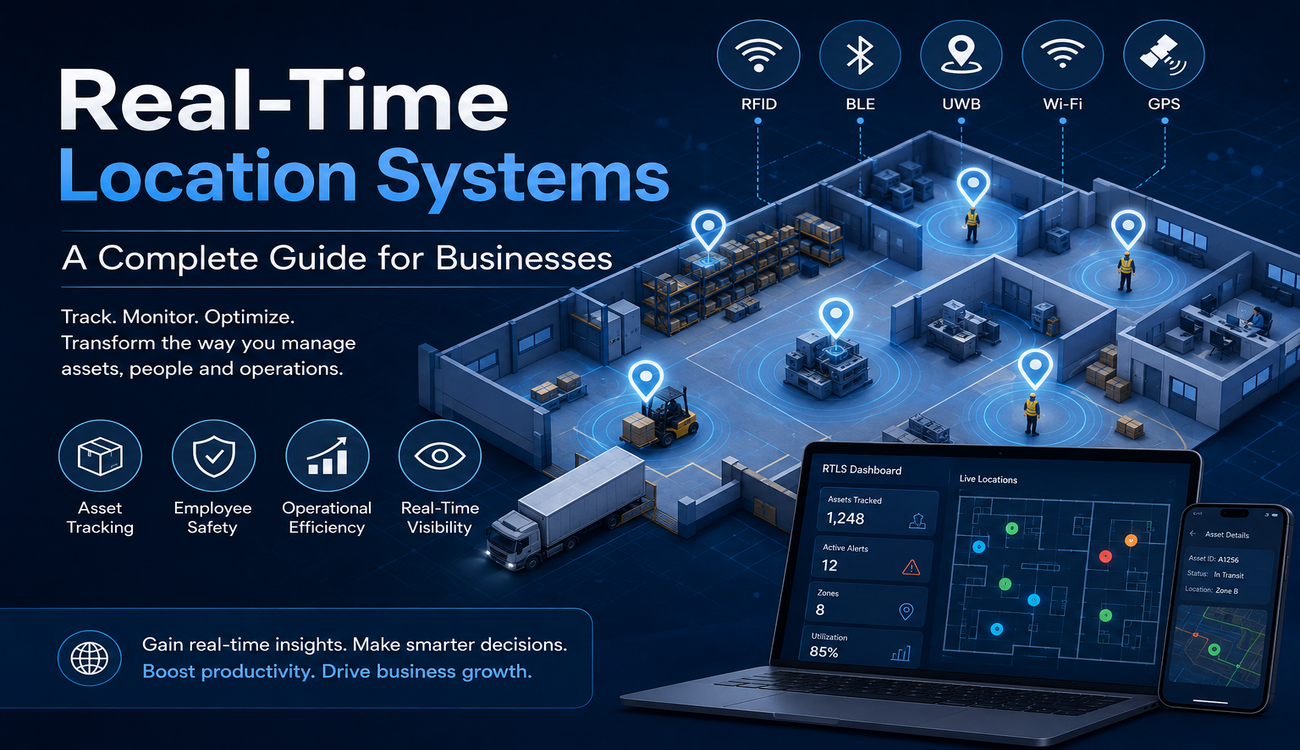
Businesses today need more than traditional tracking methods to manage people, equipment, inventory, vehicles, and other valuable resources. As operations become more complex, organizations need accurate visibility into where their assets are, how they move, and how efficiently they are being used. This is where Real-Time Location Systems have become an important technology for modern businesses.
Real-Time Location Systems, commonly known as RTLS, help organizations identify and monitor the location of tagged assets, equipment, vehicles, or people within a defined environment. By combining technologies such as RFID, Bluetooth Low Energy, Ultra-Wideband, Wi-Fi, GPS, and IoT sensors, businesses can create a connected environment where location information is available in near real time. This visibility can help companies reduce operational delays, improve resource utilization, strengthen workplace safety, and make better decisions.
What Are Real-Time Location Systems?
Real-Time Location Systems are technology-based solutions designed to determine and monitor the location of objects or people within a specific area. Unlike conventional tracking approaches that may provide information only when an item is scanned or manually updated, RTLS can continuously or periodically provide location data depending on the technology and system configuration.
A typical RTLS environment includes tags attached to assets or carried by people, location receivers or sensors installed throughout a facility, and software that collects and processes the location information. When a tag communicates with nearby sensors, the system can estimate or determine its position and display the information through a centralized dashboard.
How Real-Time Location Systems Work
The basic working process of an RTLS solution starts with a tag or tracking device associated with an asset, person, vehicle, or piece of equipment. The tag communicates with fixed infrastructure such as anchors, gateways, readers, or sensors. These devices collect signals from the tags and send the information to an RTLS software platform.
The software then processes the collected data to determine the location of the tracked object. Depending on the technology being used, positioning may be based on signal strength, time of flight, angle of arrival, triangulation, or other positioning techniques. The resulting information can be displayed on digital maps, dashboards, floor plans, or operational applications.
The system can also connect location information with business rules. For example, if an important piece of equipment enters an unauthorized area, the system can generate an alert. Similarly, if a tagged asset remains unused for an unusually long period, managers can investigate its utilization and improve resource allocation.
Why Businesses Need Real-Time Location Systems
Modern businesses often manage hundreds or thousands of physical assets across warehouses, factories, hospitals, construction sites, offices, campuses, and other environments. Finding a particular asset manually can consume valuable time and create unnecessary operational costs.
Real-Time Location Systems provide businesses with a clearer understanding of how resources are moving through their facilities. Instead of relying on manual records or periodic inspections, organizations can obtain location information much faster and use it to improve everyday operations.
Improving Asset Visibility
One of the biggest advantages of RTLS is improved asset visibility. Businesses can monitor the location of equipment, tools, containers, inventory, vehicles, and other valuable resources without depending entirely on manual tracking.
This can be particularly useful in large facilities where assets frequently move between departments or operational zones. Employees can identify where an asset was last detected or where it is currently located, reducing the time spent searching for equipment.
Increasing Operational Efficiency
Location information can reveal inefficiencies that may not be visible through conventional operational reports. Businesses can analyze movement patterns, identify unnecessary transportation, and understand how resources are being used.
For example, a manufacturing company may discover that workers regularly travel long distances to collect tools or materials. By analyzing location data, management can redesign workflows or reposition frequently used resources closer to workstations.
Supporting Workplace Safety
RTLS can also contribute to workplace safety by monitoring people, vehicles, and equipment within defined areas. Businesses can establish virtual zones and configure alerts when tagged objects enter restricted or hazardous locations.
In environments such as manufacturing plants, warehouses, construction sites, and hospitals, this capability can help organizations respond faster to specific location-based events and improve operational control.
Technologies Used in Real-Time Location Systems
Different RTLS technologies are suitable for different business environments. Selecting the right technology depends on factors such as required accuracy, facility size, environmental conditions, infrastructure, budget, and tracking requirements.
RFID-Based RTLS
RFID can be used to identify and track assets using radio-frequency tags and readers. RFID-based systems are widely used in warehouses, manufacturing facilities, healthcare environments, and supply chain operations.
Depending on the RFID technology and system design, organizations can achieve different levels of location visibility. RFID is particularly valuable where businesses already use RFID for inventory or asset identification and want to extend those capabilities into location tracking.
Bluetooth Low Energy
Bluetooth Low Energy, or BLE, is another commonly used technology for location tracking. BLE beacons and tags can communicate with gateways or receivers installed throughout a facility.
BLE-based RTLS solutions can be useful when organizations require scalable indoor tracking with relatively low-power devices. They can support applications such as asset tracking, employee location, equipment monitoring, and indoor navigation.
Ultra-Wideband
Ultra-Wideband technology is widely considered when organizations require highly accurate indoor positioning. UWB systems use anchors and tags to calculate the position of tracked objects with high precision.
This makes UWB suitable for environments where knowing the precise location of equipment, vehicles, tools, or workers is important. Manufacturing facilities, industrial environments, healthcare facilities, and high-value asset operations can benefit from this level of location accuracy.
GPS and IoT-Based Tracking
GPS is commonly used for outdoor tracking applications such as fleet management, logistics, transportation, and field operations. IoT devices can combine GPS with sensors and connectivity technologies to provide information about location as well as other operational conditions.
For businesses managing vehicles or mobile assets across large geographical areas, GPS-enabled systems can provide valuable visibility beyond the boundaries of an indoor facility.
Real-Time Location Systems Across Different Industries
RTLS technology can support a wide range of business applications because location information is relevant to almost every industry that manages physical resources.
RTLS in Manufacturing
Manufacturers can use RTLS to monitor tools, machinery, raw materials, work-in-progress items, vehicles, and employees. Location visibility can help improve production workflows and reduce the time employees spend searching for equipment.
Manufacturing organizations can also use RTLS data to understand movement between production areas and identify bottlenecks in their processes.
RTLS in Healthcare
Hospitals and healthcare facilities manage large numbers of medical devices, equipment, staff, and patients. RTLS can help healthcare organizations locate critical equipment such as infusion pumps, wheelchairs, patient monitors, and other mobile assets.
By improving equipment visibility, hospitals can potentially reduce equipment search time and improve utilization. RTLS can also support patient and staff safety applications when implemented with appropriate privacy and security controls.
RTLS in Warehousing and Logistics
Warehouses contain constantly moving inventory, vehicles, pallets, containers, and handling equipment. RTLS can provide better visibility into these movements and help businesses understand how materials travel through a facility.
Location information can support faster asset retrieval, improved warehouse workflows, and better utilization of material-handling equipment.
RTLS in Construction
Construction companies often operate across large and constantly changing sites. Tools, machinery, vehicles, and other valuable assets can easily become difficult to locate.
RTLS can provide construction teams with better visibility into asset locations and help reduce unnecessary searching. Location data can also support equipment utilization analysis and improve site management.
Key Benefits of Real-Time Location Systems
The business value of Real-Time Location Systems extends beyond simply knowing where an asset is located. When integrated with operational software, RTLS data can become a source of actionable business intelligence.
Better Resource Utilization
Organizations can identify underused or frequently misplaced assets and make better decisions about resource allocation. This can help businesses maximize the value of existing equipment instead of purchasing additional resources unnecessarily.
Reduced Operational Costs
Time spent searching for equipment, managing manual records, or investigating asset movements can create hidden operational costs. Automating location visibility can reduce these inefficiencies and allow employees to focus on more productive activities.
Faster Decision-Making
Real-time or near-real-time location data provides managers with current operational information. Instead of relying only on historical records, decision-makers can respond to actual movement patterns and location-based events.
Improved Security and Loss Prevention
RTLS can help organizations monitor high-value assets and establish virtual boundaries. Alerts can be triggered when tracked assets move into unexpected areas or leave designated zones, supporting better asset security.
Challenges Businesses Should Consider Before Implementing RTLS
Although RTLS can provide significant benefits, successful implementation requires careful planning. Businesses should first understand their operational requirements and determine the level of location accuracy they actually need.
Infrastructure requirements can vary significantly between technologies. A large industrial facility may require numerous sensors, anchors, gateways, or readers, while another environment may need a simpler deployment. Businesses should also consider device battery life, network connectivity, integration requirements, maintenance, scalability, and data security.
Choosing the Right RTLS Technology
There is no single RTLS technology that is ideal for every business. RFID may be suitable for certain inventory and asset identification applications, while UWB may be more appropriate where precise positioning is essential. BLE can offer flexibility for various indoor applications, whereas GPS is generally more suitable for outdoor tracking.
The right choice should therefore be based on the business environment, tracking objectives, required accuracy, and expected return on investment rather than selecting a technology simply because it is widely used.
How Businesses Can Successfully Implement Real-Time Location Systems
A successful RTLS implementation starts with clearly defining the business problem. Instead of deploying tracking technology across an entire organization immediately, companies can identify a specific operational challenge and begin with a focused use case.
The next step is evaluating the environment and selecting the appropriate tracking technology. Businesses should assess facility layout, required accuracy, connectivity, existing infrastructure, and integration needs before deployment.
Integration with existing business systems is equally important. RTLS can become more valuable when location information is connected with ERP, warehouse management, asset management, fleet management, healthcare, or other operational platforms. This allows organizations to combine location data with existing business information and create more useful workflows.
A pilot deployment can also help businesses validate the technology before expanding it across multiple sites. Organizations can measure improvements in asset visibility, search time, utilization, safety, or operational efficiency and use those results to guide larger deployments.
The Future of Real-Time Location Systems
The future of Real-Time Location Systems is closely connected with IoT, artificial intelligence, automation, digital twins, and advanced analytics. As businesses collect more location data, they can move beyond basic tracking toward predictive and intelligent operations.
Instead of simply showing where an asset is, future RTLS platforms can help organizations understand where assets are likely to be needed, identify unusual movement patterns, predict operational bottlenecks, and automate responses to location-based events.
The combination of RTLS with digital twins can also create virtual representations of physical facilities. Businesses can visualize the movement of assets, people, and vehicles within a digital environment and use this information to optimize processes before making physical changes.
Conclusion
Real-Time Location Systems are becoming an important part of modern business operations because they provide visibility into the movement and location of physical resources. From manufacturing and healthcare to logistics, warehousing, and construction, organizations can use RTLS to improve asset visibility, operational efficiency, safety, security, and resource utilization.
However, successful RTLS adoption depends on choosing the right technology and designing the system around specific business requirements. By starting with clear objectives, selecting an appropriate tracking method, integrating RTLS with existing systems, and measuring business outcomes, organizations can turn location data into meaningful operational value.
As IoT, automation, analytics, and intelligent technologies continue to evolve, Real-Time Location Systems are likely to become an increasingly important foundation for connected and data-driven business environments.
FAQs
Q1. What are Real-Time Location Systems used for?
Real-Time Location Systems are used to track and monitor the location of assets, equipment, vehicles, inventory, and people within a defined area. Businesses use RTLS to improve asset visibility, operational efficiency, safety, security, and resource utilization.
Q2. How do Real-Time Location Systems work?
Real-Time Location Systems use technologies such as RFID, BLE, UWB, GPS, Wi-Fi, and IoT sensors to collect location data. Tags attached to assets or carried by people communicate with readers, sensors, or anchors, allowing the system to determine and display their location.
Q3. Which industries can benefit from Real-Time Location Systems?
Manufacturing, healthcare, logistics, warehousing, construction, retail, transportation, and other industries can benefit from Real-Time Location Systems. They are particularly useful for organizations that manage large numbers of mobile assets, equipment, vehicles, or people.
Q4. What is the difference between RTLS and traditional asset tracking?
Traditional asset tracking often depends on manual records, periodic scans, or fixed checkpoints. RTLS provides more continuous or near-real-time visibility into asset locations, helping businesses identify where resources are located and how they move through an environment.
Q5. How do businesses choose the right Real-Time Location System?
Businesses should consider required location accuracy, facility size, tracking environment, number of assets, connectivity, scalability, budget, and integration requirements. RFID, BLE, UWB, GPS, and other technologies offer different capabilities, so the right choice depends on the specific business use case.