
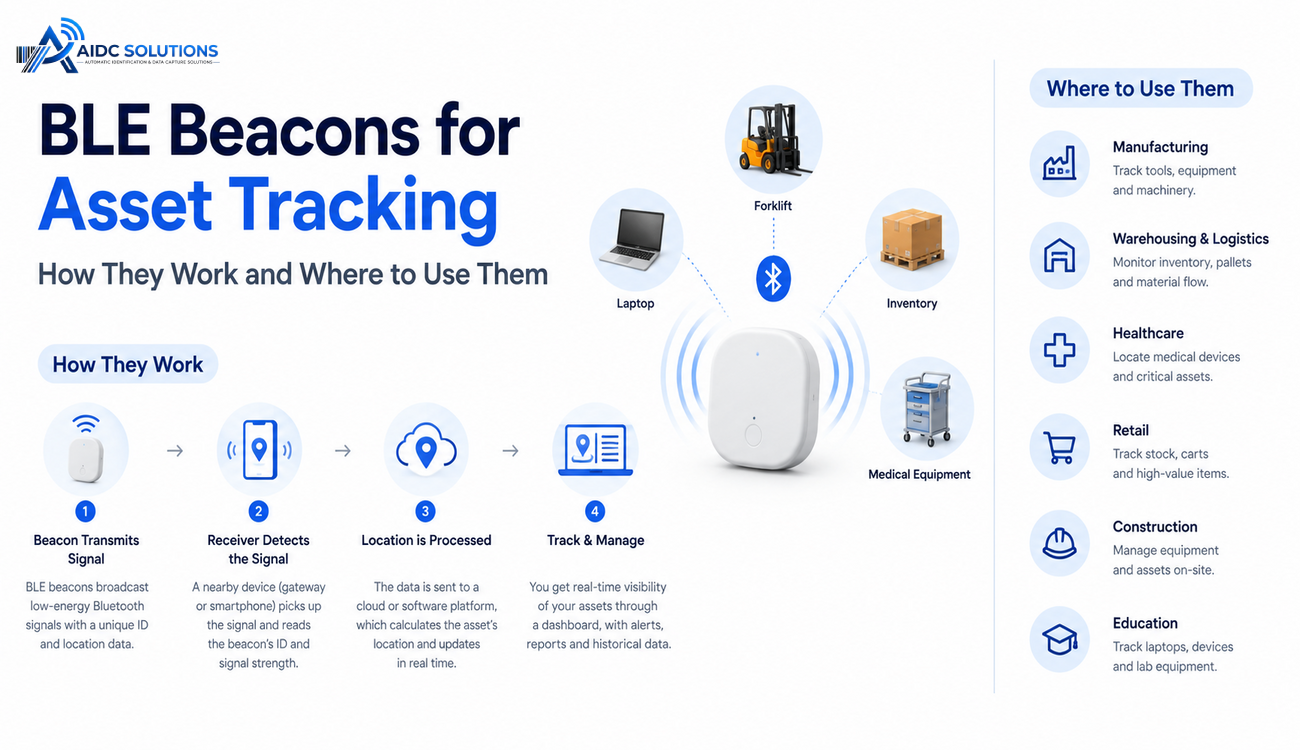
Businesses across industries depend on equipment, tools, inventory, and other valuable assets to maintain smooth daily operations. However, tracking these assets becomes challenging when they move between departments, warehouses, production floors, and multiple business locations. Manual tracking methods and traditional asset management systems may not always provide the visibility required to locate items quickly and prevent unnecessary losses. This is where BLE technology offers a practical solution.
BLE Beacons for Asset Tracking help organizations improve asset visibility by using Bluetooth Low Energy signals to identify nearby assets and support location monitoring. These compact, wireless devices can be attached to equipment, tools, containers, and other movable items, allowing compatible receivers to detect their signals. Compared with some traditional tracking technologies, BLE beacons can offer a cost-effective approach to monitoring assets across indoor environments.
As businesses continue to adopt connected technologies, BLE beacon systems are becoming an important part of modern asset management strategies. They help organizations understand where assets are located, how frequently they are used, and when operational teams may need to take action. Understanding how this technology works and where it delivers the most value can help businesses decide whether it fits their tracking requirements.
What are BLE Beacons for Asset Tracking?
Bluetooth Low Energy (BLE) is a wireless communication technology designed to transmit small amounts of data while consuming relatively little power. A BLE beacon is a compact transmitter that periodically broadcasts a Bluetooth signal containing an identifier or other configured information. Compatible devices, such as gateways, smartphones, and Bluetooth-enabled receivers, detect these signals and forward relevant information to an asset tracking platform.
BLE Beacons for Asset Tracking use this communication method to associate physical assets with digital records. For example, a manufacturer can attach a beacon to a machine, allowing nearby receivers to detect its presence in a designated production area. The tracking platform can then use receiver information and configured location rules to help staff identify the asset’s last detected location or approximate area.
Unlike GPS trackers, BLE beacons generally do not determine their own precise geographic coordinates. Their location information depends on the surrounding Bluetooth infrastructure, receiver placement, signal characteristics, and the positioning method used by the tracking system. This makes them particularly useful for indoor environments where GPS signals may be weak or unavailable.
How BLE Beacons for Asset Tracking Work
Understanding the operating process helps businesses evaluate the technology and determine how it can fit into their existing infrastructure.
1. Beacon Installation on Assets
The process begins by attaching a BLE beacon to an asset that requires monitoring. Depending on the application, beacons can be installed on industrial equipment, medical devices, reusable containers, tools, or warehouse inventory.
Each beacon broadcasts a configured identifier that allows the tracking platform to associate detected signals with a specific asset record. The asset database may contain additional details, including the asset’s name, serial number, assigned department, maintenance history, and ownership information.
2. Wireless Signal Broadcasting
After installation, the beacon periodically transmits Bluetooth signals. These broadcasts can be configured according to the beacon’s capabilities and the organization’s tracking requirements.
The transmission interval and signal strength influence battery consumption, detection frequency, and practical coverage. More frequent broadcasts may help receivers detect an asset sooner, but they can also increase power consumption. Businesses must balance these factors to achieve suitable performance without requiring unnecessarily frequent battery replacements.
3. Signal Detection by Receivers
Bluetooth-enabled gateways, strategically placed receivers, or compatible mobile devices detect beacon broadcasts within their reception range. When a receiver identifies a signal, it can capture information such as the beacon identifier, reception time, and received signal strength indicator (RSSI).
The receiver may then send this information to a central platform through a network connection. Depending on the deployment, communication between gateways and the platform may use Wi-Fi, Ethernet, or another supported network technology.
4. Location Estimation and Data Processing
The asset tracking platform processes the information collected by receivers to estimate an asset’s location or identify the area where it was last detected. In a basic deployment, a receiver can indicate that an asset is present within a particular room, zone, or operational area.
More advanced configurations may use multiple receivers and signal measurements to estimate proximity or approximate indoor position. However, signal strength can fluctuate because of walls, metal surfaces, physical obstructions, and interference. Consequently, location accuracy depends on the environment, receiver density, calibration, and positioning method.
5. Monitoring Through a Central Dashboard
Once the platform processes the incoming information, employees can view asset records and location updates through a dashboard. Depending on the system’s capabilities, users may receive notifications when assets enter or leave designated zones, remain undetected for a defined period, or appear in an unexpected area.
These insights help organizations reduce manual searches, improve equipment utilization, and make more informed operational decisions.
Key Benefits of BLE Beacon-Based Asset Tracking
Improved Asset Visibility
One of the main advantages of BLE Beacons for Asset Tracking is improved visibility into the location of movable equipment and resources. Employees can identify the last detected area of an asset without checking multiple storage rooms or relying on manual records. This is particularly valuable in large facilities where equipment frequently moves between teams or departments.
Cost-Effective Deployment
BLE beacons are generally compact and relatively affordable compared with some more complex tracking devices. They can also operate without a continuous power connection when supported by battery-powered designs. Organizations can deploy them across selected assets and expand the system as requirements grow, provided that suitable receivers and network infrastructure are available.
Low Power Consumption
Bluetooth Low Energy is designed to reduce wireless communication power requirements. This enables compatible beacons to operate for extended periods on batteries, depending on transmission settings, battery capacity, environmental conditions, and device design. Lower maintenance requirements can make BLE technology attractive for tracking large numbers of movable assets.
Better Equipment Utilization
When businesses have more reliable information about asset locations and movement, they can identify underused equipment and unnecessary duplicate purchases. For example, a warehouse manager may discover that certain tools remain unused in one area while another team repeatedly requests the same equipment.
Support for Operational Automation
BLE tracking data can be integrated with asset management software, inventory platforms, and enterprise applications. With suitable integration, organizations can automate location-based notifications, maintain movement records, and support workflows such as equipment allocation and asset audits.
Where Can BLE Beacons for Asset Tracking Be Used?
The technology can support a variety of operational environments, although the most suitable implementation depends on asset value, movement patterns, location accuracy requirements, and infrastructure availability.
1. Manufacturing and Industrial Facilities
Manufacturing businesses use machinery, maintenance tools, testing equipment, work-in-progress containers, and other resources across production areas. Finding the correct equipment can become difficult when multiple teams share assets or move them between workstations.
BLE Beacons for Asset Tracking can help manufacturers identify the last detected zone of tools and equipment, monitor movement between designated areas, and improve asset availability. Integration with maintenance systems may also help technicians locate equipment before scheduled inspections or repairs.
For example, a factory can use BLE receivers in its assembly, maintenance, and storage areas to identify where shared diagnostic tools were last detected. This reduces time spent searching and supports more efficient production planning.
2. Warehouses and Distribution Centers
Warehouses often handle reusable pallets, containers, carts, handling equipment, and high-value inventory. Manual tracking becomes increasingly difficult when assets move frequently throughout large storage facilities.
BLE beacon systems can help warehouse teams identify the approximate location or last detected zone of tagged assets. This can simplify internal searches, support asset movement analysis, and improve the management of reusable transport equipment.
When combined with warehouse management software, BLE data can complement existing inventory records and help staff investigate misplaced assets more efficiently.
3. Healthcare and Hospitals
Hospitals depend on the availability of medical equipment, including wheelchairs, infusion pumps, portable monitors, and diagnostic devices. When staff cannot quickly locate essential equipment, workflows may be delayed and patient care operations can become less efficient.
BLE Beacons for Asset Tracking can help healthcare facilities monitor tagged equipment across wards, storage areas, laboratories, and other designated zones. Staff can use location dashboards to identify the last detected area of an item and reduce time spent searching for shared resources.
Healthcare deployments should also account for patient privacy, equipment compatibility, cleaning procedures, and hospital network security requirements.
4. Offices and Corporate Campuses
Large offices and corporate campuses contain shared laptops, presentation equipment, projectors, conference room devices, and other movable resources. Equipment may be transferred between departments without consistent updates to asset registers.
BLE tracking can improve visibility into shared assets and help administrative teams identify where equipment was last detected. Businesses can also configure location-based rules to flag unexpected movement or assets that remain outside their assigned zones.
This can support more organized asset allocation, particularly in organizations with multiple floors, buildings, or office locations.
5. Construction Sites
Construction projects involve tools, portable machinery, testing devices, and reusable equipment that move between work zones. Keeping track of these resources can be difficult when several contractors operate across the same site.
BLE beacon systems can help site managers monitor the presence of tagged equipment in designated areas and investigate missing or misplaced tools. Their usefulness depends on receiver coverage, site conditions, and whether assets move beyond the monitored area.
For outdoor tracking over long distances, BLE may need to be combined with GPS or other suitable technologies.
6. Retail and Commercial Facilities
Retail businesses use shopping carts, handheld devices, stockroom equipment, reusable containers, and other movable assets. BLE technology can help identify where tagged resources were last detected and highlight movement between designated store zones.
In larger retail operations, asset location information can support equipment allocation, reduce time spent searching for shared devices, and improve the management of resources across multiple departments.
BLE Beacons vs. Other Asset Tracking Technologies
Different tracking technologies serve different operational needs. BLE should be evaluated according to the required coverage, accuracy, infrastructure, and cost.
| Technology | Main Strength | Common Use |
|---|---|---|
| BLE beacons | Low-power broadcasting and indoor zone monitoring | Tools, equipment, and reusable assets |
| RFID | Fast identification of tagged items using readers | Inventory counts, warehouse operations, and item identification |
| GPS | Outdoor geographic positioning | Vehicles, outdoor equipment, and mobile assets |
| Wi-Fi positioning | Location estimation using Wi-Fi infrastructure | Indoor devices and facility-level tracking |
| UWB | High-precision ranging in suitable deployments | Applications requiring more accurate indoor positioning |
BLE can complement RFID when organizations need ongoing zone-level visibility in addition to identification at checkpoints. GPS is generally more appropriate for outdoor geographic tracking, while UWB may be preferable when precise indoor positioning is a key requirement.
A hybrid deployment can combine technologies to address different stages of an asset’s movement.
Challenges and Limitations of BLE Beacon Tracking
Although BLE offers several advantages, businesses should consider its limitations before implementing a tracking solution. Understanding these challenges helps organizations select appropriate hardware, design reliable receiver coverage, and establish realistic expectations.
Location Accuracy and Signal Interference
BLE signals can be affected by walls, metal equipment, machinery, and other physical obstructions. These factors may cause signal strength to fluctuate, making precise indoor positioning more difficult. Organizations should test receiver placement and evaluate whether zone-level detection or more advanced positioning is necessary.
Battery Maintenance
Battery-powered beacons require periodic maintenance or replacement. Battery life varies according to transmission frequency, signal strength, battery capacity, and environmental conditions. A suitable asset tracking platform should help teams monitor device status when supported by the hardware.
Infrastructure Requirements
A beacon alone does not provide complete, centralized asset visibility. Organizations typically need compatible receivers, network connectivity, asset records, and tracking software. The number and placement of receivers influence coverage and the reliability of location information.
Security and Data Management
Businesses must protect tracking data against unauthorized access and ensure that connected devices are configured appropriately. BLE Beacons for Asset Tracking should be deployed with suitable access controls, secure network communication, and regular device maintenance. Organizations should also establish clear policies for data retention and system access.
Best Practices for Implementing BLE Beacon Tracking
Successful implementation begins with a clear understanding of the business problem rather than installing beacons across every available asset.
Identify the Assets That Need Monitoring
Start by identifying high-value, frequently misplaced, or operationally critical assets. Define the expected outcome, such as reducing search time, improving equipment availability, or monitoring movement between departments. This makes it easier to evaluate whether the deployment delivers measurable benefits.
Select Suitable Beacons and Receivers
Choose devices according to the operating environment, expected battery life, mounting requirements, transmission settings, and environmental durability. Receiver placement should reflect the facility layout and the required level of location visibility.
Integrate With Existing Business Systems
Connecting BLE data with asset management software can help organizations maintain consistent records and make location information more useful. BLE Beacons for Asset Tracking become more valuable when their data supports existing workflows, such as equipment allocation, maintenance planning, and internal audits.
Test Before Expanding the Deployment
Begin with a pilot project in a limited area. Measure detection reliability, location accuracy, battery performance, and user adoption before extending the system across the organization. Testing under actual operating conditions can reveal coverage gaps and configuration issues that may not appear during initial planning.
Monitor Performance and Improve Continuously
After deployment, review key performance indicators such as average asset search time, missing asset incidents, equipment utilization, and maintenance effort. Regular reviews help organizations identify opportunities to improve receiver coverage and optimize system settings.
The Future of BLE Beacons in Asset Management
The future of BLE-based tracking is closely connected to the growth of the Internet of Things (IoT), connected workplaces, and data-driven operations. As organizations connect more equipment and operational systems, location information can become part of broader business intelligence and automation initiatives.
BLE Beacons for Asset Tracking can support increasingly connected workflows when integrated with IoT platforms, analytics tools, and enterprise applications. Businesses may use accumulated location data to understand asset movement patterns, identify frequently congested areas, and improve equipment distribution across facilities.
Emerging Bluetooth capabilities and improvements in positioning methods may also support more sophisticated location services. However, the practical benefits will depend on device compatibility, infrastructure design, and the specific requirements of each deployment.
For organizations managing assets across multiple sites, combining BLE with RFID, GPS, or other technologies may provide more comprehensive visibility than relying on a single tracking method. The right combination depends on whether the priority is identifying individual items, monitoring indoor zones, or tracking assets over long distances.
Conclusion
Asset visibility is essential for businesses that want to reduce operational delays, improve equipment utilization, and manage resources more efficiently. BLE technology provides a practical way to monitor the presence and approximate location of movable assets without requiring every device to have a continuous power connection.
BLE Beacons for Asset Tracking are particularly useful in manufacturing facilities, warehouses, hospitals, offices, construction sites, and retail environments where assets frequently move between designated areas. Their low-power operation, flexible deployment options, and integration capabilities make them a valuable component of modern asset management systems.
However, successful implementation requires appropriate receiver coverage, reliable asset records, secure data handling, and realistic location accuracy expectations. By starting with clear objectives and testing the technology in real operating conditions, businesses can determine how BLE fits into their wider asset tracking strategy and build a more connected, efficient operational environment.
FAQs
Q1. What are BLE Beacons for Asset Tracking?
BLE Beacons for Asset Tracking are small wireless devices that use Bluetooth Low Energy technology to broadcast signals detected by compatible receivers. These signals help businesses identify the presence and approximate location of tagged assets, such as tools, medical equipment, machinery, and warehouse containers.
Q2. How do BLE beacons track assets indoors?
BLE beacons periodically transmit unique identifiers that nearby Bluetooth receivers detect. The receivers send this information to an asset tracking platform, which uses receiver locations and signal data to estimate the asset’s location or last detected zone. Accuracy depends on receiver placement, environmental conditions, and the positioning method.
Q3. What industries can benefit from BLE beacon asset tracking?
Manufacturing, healthcare, logistics, warehousing, construction, retail, and corporate offices can benefit from BLE beacon tracking. These industries use the technology to locate shared equipment, monitor asset movement, reduce search time, and improve resource utilization across different operational areas.
Q4. What is the difference between BLE beacons and RFID tracking?
BLE beacons periodically broadcast Bluetooth signals that receivers can detect, supporting ongoing asset presence and location monitoring. RFID systems identify tagged items using radio-frequency readers and are commonly used for inventory checks and checkpoint-based tracking. The best option depends on coverage, identification speed, location requirements, and deployment costs.
Q5. What factors should businesses consider before implementing BLE asset tracking?
Businesses should evaluate location accuracy requirements, beacon battery life, receiver coverage, installation costs, software integration, and data security. Testing the system in a real operating environment helps identify signal interference and coverage gaps before expansion. A pilot deployment can also help measure improvements in asset visibility and operational efficiency.