
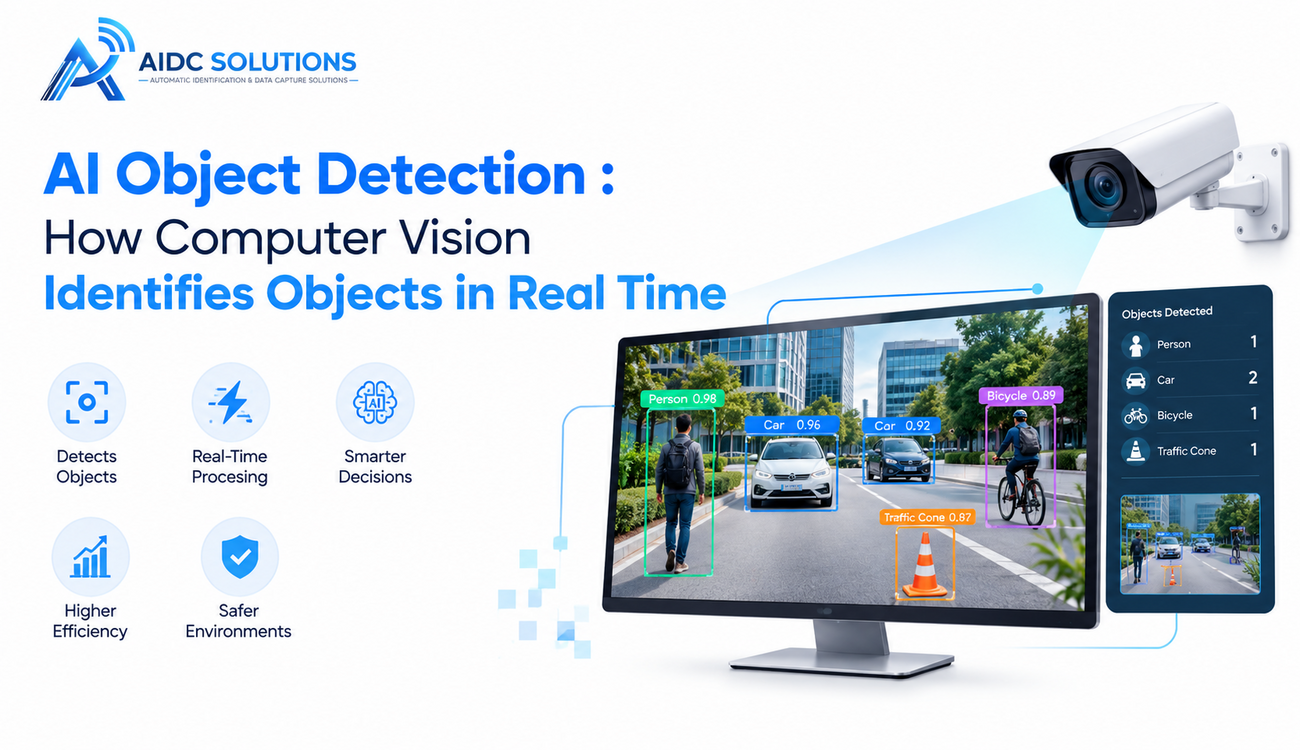
Artificial intelligence is changing how machines understand and interact with the world. From identifying vehicles on busy roads to detecting defective products on manufacturing lines, computer vision is helping businesses analyze visual information faster and more accurately. One of the most important technologies behind these capabilities is AI Object Detection, which enables computer systems to identify objects, determine their locations, and recognize multiple items within images or video streams.
Unlike traditional image processing methods that depend on predefined rules, modern object detection systems use deep learning models to recognize patterns in visual data. These systems can process live camera feeds, detect objects in changing environments, and provide useful information for automated decision-making. As organizations increasingly adopt intelligent automation, real-time object detection is becoming valuable across manufacturing, healthcare, retail, transportation, logistics, and security.
Understanding how this technology works, which applications benefit from it, and what challenges businesses must consider can help organizations identify the right opportunities for implementation.
What is AI Object Detection?
AI Object Detection is a computer vision technique that enables machines to identify specific objects in images or video footage and determine their positions within a visual scene. The technology typically identifies objects by assigning class labels and drawing bounding boxes around detected items.
For example, a camera installed at a warehouse entrance can recognize workers, forklifts, pallets, and delivery vehicles simultaneously. The system can distinguish these objects and estimate their locations without requiring a person to examine every frame manually.
Object detection combines image processing, machine learning, and deep learning to transform visual information into structured data. Instead of simply determining whether an image contains a particular object, it can identify multiple objects and locate them within the same frame.
This capability makes the technology useful for applications that require continuous monitoring, rapid analysis, and automated responses. Depending on the model and deployment environment, detection systems can operate on cloud infrastructure, local servers, edge devices, or embedded hardware.
How AI Object Detection Works in Real Time
Real-time detection involves more than recognizing objects in a single image. The system must capture incoming visual data, process it efficiently, identify relevant objects, and generate results quickly enough to support time-sensitive decisions.
Image and Video Acquisition
The process begins when cameras, smartphones, industrial imaging devices, or other visual sensors capture images and video frames. The quality of this input directly influences the accuracy of subsequent detection.
Lighting conditions, camera angles, motion blur, image resolution, and environmental obstacles can affect how clearly objects appear. For example, a vehicle detection system operating at night may require suitable cameras and image enhancement techniques to identify vehicles reliably.
In industrial environments, cameras are often positioned at specific locations to monitor production lines, equipment, products, or restricted areas.
Image Preprocessing
Before the model analyzes an image, the input may undergo preprocessing to make it suitable for inference. This can involve resizing images, normalizing pixel values, adjusting image formats, and preparing data for the selected neural network.
Preprocessing helps maintain consistent model inputs and can reduce computational requirements. However, excessive resizing or poor image quality can remove important visual details, particularly when detecting small objects from a distance.
The appropriate preprocessing approach depends on the camera specifications, object sizes, processing hardware, and performance requirements of the application.
Object Recognition and Localization
The detection model examines visual features such as edges, shapes, textures, and patterns to identify objects within an image. Deep learning architectures learn these features from training data rather than relying entirely on manually written rules.
Modern models, including YOLO-based architectures and Faster R-CNN, use different approaches to locate and classify objects. YOLO models are widely used when speed is important, while other architectures may be selected when their accuracy and computational characteristics better match the application.
The model produces predictions that commonly include an object class, a bounding box, and a confidence score. The confidence score estimates how strongly the model supports a particular prediction, although it should not automatically be interpreted as a perfectly calibrated probability.
Post-Processing and Detection Results
After generating predictions, the system may apply post-processing to remove redundant detections and refine the final output. Non-maximum suppression is a common technique that helps eliminate overlapping bounding boxes representing the same object.
The resulting detections can then be displayed on a monitoring dashboard, transmitted to another software system, or used to trigger an automated workflow.
For example, a manufacturing system might flag a product with a visible defect, while a traffic monitoring platform could estimate vehicle counts and identify congestion patterns.
Real-Time Processing and Response
The final stage involves delivering detection results quickly enough to support the intended task. Real-time performance depends on the complete processing pipeline, including image capture, preprocessing, model inference, post-processing, and communication.
A system processing video at a high frame rate may require a GPU, an optimized neural network, or dedicated edge hardware. Applications with strict latency requirements may also reduce input resolution or use smaller models to achieve faster processing.
The goal is not simply to identify objects correctly but to provide reliable results within the time constraints of the operational environment.
Key Technologies Behind Real-Time Object Detection
Several technologies contribute to modern detection systems, and the best combination depends on the complexity of the task and the required performance.
Deep Learning and Convolutional Neural Networks
Deep learning allows computers to learn complex visual patterns from large datasets containing labeled images. Convolutional neural networks have traditionally played an important role in computer vision because they can extract useful spatial features from images.
These learned features help detection models distinguish objects that may have different shapes, colors, sizes, or appearances. Training data must represent the conditions in which the system will operate to support dependable performance.
YOLO and Other Detection Models
YOLO, which stands for You Only Look Once, is a family of object detection models designed to predict object locations and classes efficiently. Its speed makes it suitable for applications such as traffic monitoring, industrial inspection, and live video analytics.
Faster R-CNN uses a region proposal-based approach and can be useful when detection quality is a priority and additional processing time is acceptable. Other architectures, including single-shot detectors and transformer-based models, may also be appropriate for specific use cases.
Model selection should consider detection accuracy, inference speed, hardware requirements, object size, and the complexity of the operating environment rather than relying on a single benchmark.
Edge AI and Hardware Acceleration
Edge computing enables visual data to be processed near the camera or sensor instead of sending every frame to a remote cloud server. This can reduce network traffic, improve responsiveness, and help organizations maintain local processing when connectivity is limited.
GPUs, neural processing units, and other hardware accelerators can improve inference performance by executing computationally intensive operations efficiently.
For facilities that operate many cameras, a hybrid architecture may combine edge-based detection with centralized analytics, long-term storage, and reporting.
Real-World Applications of AI Object Detection
AI Object Detection is increasingly used in environments where organizations need to interpret visual information continuously and convert it into actionable insights.
Manufacturing and Quality Inspection
Manufacturers can use object detection to identify missing components, damaged packaging, incorrect assemblies, and visible product defects. Automated inspection can help standardize quality checks and reduce the need for repetitive manual examination.
When integrated with production systems, detection results can flag products for further inspection or initiate alerts when defects exceed defined thresholds. The reliability of these workflows depends on representative training data, suitable imaging equipment, and validation under actual production conditions.
Smart Traffic Management and Transportation
Transportation authorities can use detection systems to identify cars, buses, motorcycles, pedestrians, and other road users. Analyzing these detections over time can support vehicle counting, traffic flow monitoring, congestion analysis, and road safety initiatives.
When combined with object tracking, detection can also help systems follow vehicles across consecutive video frames. However, automated traffic enforcement and safety-critical decisions require additional safeguards, testing, and appropriate human oversight.
Healthcare and Medical Imaging
Computer vision can assist healthcare professionals by identifying visual patterns in medical images and highlighting areas that may require closer examination. Depending on the application, AI systems may detect anatomical structures, abnormalities, or specific features in radiology and other imaging workflows.
These systems should be designed for clearly defined clinical purposes and evaluated using appropriate medical datasets. Detection results are intended to support qualified professionals rather than replace clinical judgment or established diagnostic procedures.
Retail and Inventory Management
Retail businesses can use visual detection to recognize products on shelves, monitor checkout activities, and identify areas where inventory may need replenishment. Cameras combined with computer vision can help analyze shelf availability and product placement.
When connected with inventory management software, these insights can support more timely stock updates and reduce some repetitive monitoring tasks. Privacy, camera placement, product similarity, and changing shelf layouts must be considered during implementation.
Security and Workplace Safety
Organizations can deploy object detection to identify people, vehicles, protective equipment, and potentially unsafe activities in monitored areas. Industrial facilities may use it to detect whether workers are wearing helmets or entering restricted zones.
Automated alerts can help safety teams respond more quickly to specific events. However, detection accuracy should be tested under different lighting conditions, clothing variations, occlusions, and camera positions before the system is used for operational safety decisions.
Benefits of Real-Time Object Detection
One of the main advantages of AI Object Detection is its ability to analyze large volumes of visual information without requiring a person to review every image individually. This can help organizations increase monitoring capacity while allowing employees to focus on tasks that require judgment and expertise.
Automated detection can improve operational consistency by applying the same defined criteria across repeated inspections. It can also support faster alerts when systems identify conditions that require attention, such as a defective product or an unauthorized vehicle.
Another important benefit is scalability. Once a model has been validated for a specific task, organizations can deploy it across additional cameras or facilities, provided the hardware, environmental conditions, and operational requirements remain suitable.
The technology can also generate structured visual data that supports reporting, trend analysis, and integration with enterprise applications. When implemented carefully, these capabilities can improve visibility into operations and help businesses make more informed decisions.
Challenges in Implementing AI Object Detection
Despite its advantages, object detection can be affected by poor lighting, overlapping objects, unusual viewing angles, low image resolution, and changes in environmental conditions. A model trained on clear daytime images, for example, may perform poorly in darkness or heavy rain.
Training data is another important consideration. Incomplete, imbalanced, or inaccurately labeled datasets can lead to missed detections and incorrect classifications. Organizations should evaluate models using data that reflects the real conditions in which they will be deployed.
Computational costs can also become significant when processing high-resolution video from multiple cameras. Businesses must balance accuracy, processing speed, infrastructure expenses, and ongoing maintenance requirements.
Privacy and security require equal attention. Camera-based systems should follow applicable data protection requirements, restrict access to recorded footage, and establish clear policies for retention and use.
Continuous monitoring is essential because model performance can deteriorate as products, environments, camera positions, and operating conditions change. Regular evaluation and retraining may be necessary to maintain dependable results.
Best Practices for Implementing Real-Time Object Detection
A successful implementation begins with a clearly defined business objective, such as identifying manufacturing defects, counting vehicles, or monitoring workplace safety. The objective should determine which objects the model must recognize and how quickly it must produce results.
Organizations should select representative training data and evaluate performance using appropriate measures, including precision, recall, inference latency, and the frequency of false detections. Testing should cover different lighting conditions, object sizes, camera angles, and environmental variations.
The deployment architecture should match the application’s processing requirements. Edge inference may suit low-latency environments, while cloud infrastructure can support centralized management and large-scale analytics.
Integration with existing systems should be planned early so detection results can support relevant workflows rather than remain isolated outputs. Finally, organizations should establish monitoring procedures, data governance policies, and maintenance plans before expanding the solution across multiple locations.
The Future of Real-Time Object Detection
Advances in computer vision are making detection systems more efficient, adaptable, and capable of operating in complex environments. Improved neural network architectures, model compression, hardware acceleration, and edge AI are helping developers build solutions that process visual data with lower latency and more efficient resource use.
Multimodal AI is also creating opportunities to combine visual information with language, sensor readings, and contextual data. This can help systems interpret detected objects within a broader operational scenario instead of treating each image as an isolated input.
Future applications may increasingly combine detection, object tracking, anomaly detection, and automated decision support. However, progress will depend on reliable data, suitable evaluation methods, responsible deployment, and clear human oversight.
Conclusion
Real-time computer vision is changing how organizations monitor environments, inspect products, manage inventory, and improve operational safety. By combining image acquisition, deep learning, object localization, and efficient inference, modern detection systems can transform visual data into useful business insights.
AI Object Detection offers practical opportunities for organizations seeking to automate visual inspection and improve real-time awareness. Its success, however, depends on selecting suitable models, preparing representative datasets, deploying appropriate hardware, and continuously evaluating performance.
For businesses exploring computer vision solutions, the most effective approach is to begin with a measurable operational challenge and build a system around its actual requirements. With careful planning and responsible implementation, object detection can become a valuable part of a broader digital transformation strategy.
FAQs
Q1. What is AI Object Detection?
AI Object Detection is a computer vision technology that identifies objects in images and videos and determines their locations using bounding boxes. It uses machine learning and deep learning models to recognize items such as people, vehicles, products, and equipment, helping businesses automate visual monitoring and improve operational efficiency.
Q2. How does AI Object Detection work in real time?
AI Object Detection works by capturing images or video frames, preprocessing the visual data, and analyzing it with a trained deep learning model. The model identifies objects, assigns class labels, and estimates their locations. The system then processes the results to provide alerts, display detections, or trigger automated actions with minimal delay.
Q3. Which algorithms are commonly used for AI Object Detection?
Popular object detection algorithms include YOLO, Faster R-CNN, and single-shot detectors such as SSD. YOLO is commonly selected for speed-sensitive applications, while Faster R-CNN can be suitable when its detection performance justifies additional computational requirements. The right algorithm depends on accuracy, latency, hardware, and application needs.
Q4. What are the major applications of AI Object Detection?
AI Object Detection is used in manufacturing for defect identification, healthcare for medical image analysis, retail for shelf monitoring, transportation for vehicle detection, and security for workplace safety monitoring. It also supports warehouse automation, inventory management, traffic analysis, and smart city applications by converting visual information into actionable insights.
Q5. What are the main challenges of implementing AI Object Detection?
The main challenges include poor lighting, overlapping objects, inaccurate training data, limited computing resources, and changing environmental conditions. Privacy and data security are also important considerations. Organizations can address these challenges through representative datasets, suitable hardware, performance testing, regular model updates, and responsible data management practices.