
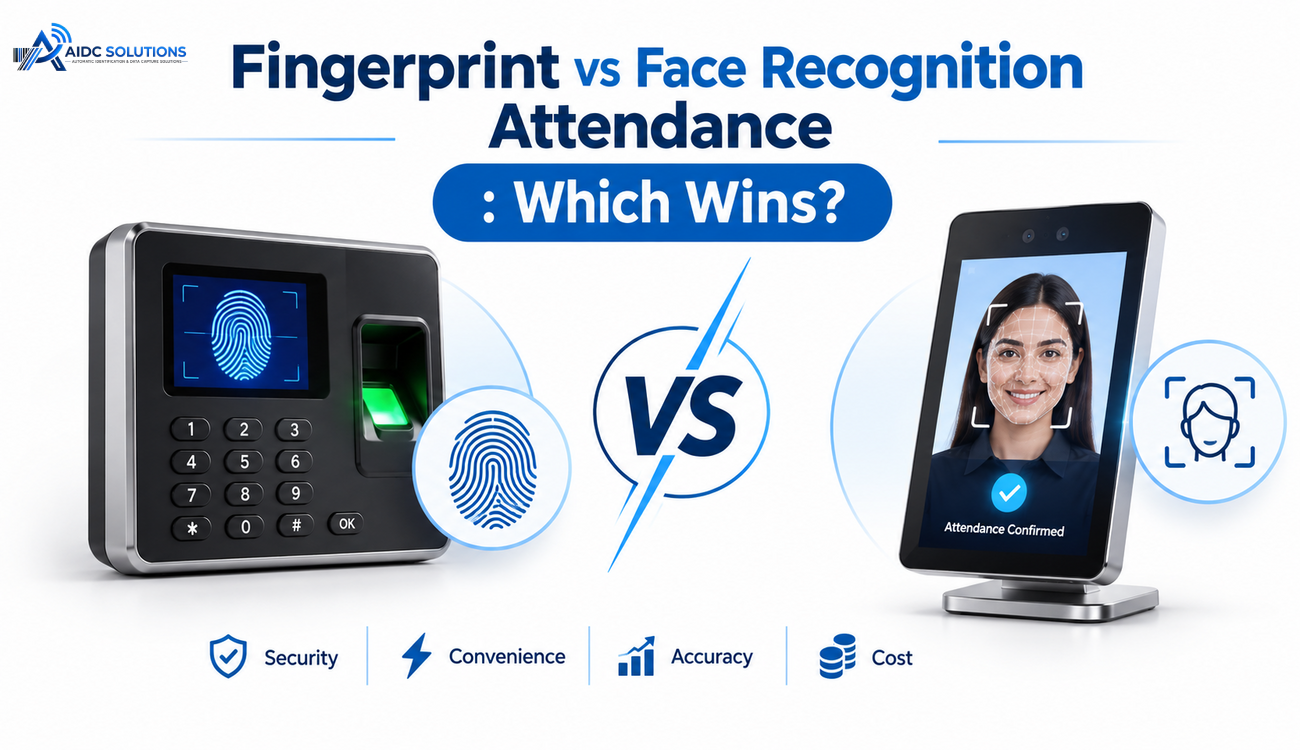
Managing employee attendance accurately is an important part of running a successful business. Traditional attendance registers and manual punch-in systems often create problems such as time theft, buddy punching, inaccurate records, and administrative delays. As organizations grow, they need smarter ways to track employee working hours while maintaining accuracy and accountability.
Biometric technology has changed how businesses manage workforce attendance. Fingerprint scanners and face recognition systems are two popular options that help organizations automate employee identification and attendance tracking. However, choosing between these technologies requires understanding their accuracy, convenience, security, cost, and suitability for different working environments.
When comparing Fingerprint vs Face Recognition Attendance, businesses need to consider more than just how employees mark their presence. The right technology should support daily operations, reduce administrative work, improve workforce visibility, and provide a reliable attendance management experience.
Both technologies offer valuable benefits, but their performance can vary depending on workforce size, workplace conditions, security requirements, and organizational needs. Let’s explore how these systems compare and which one makes a better choice for modern businesses.
What is a Fingerprint Attendance System?
A fingerprint attendance system uses biometric identification to recognize employees through the unique patterns present on their fingertips. Every employee registers their fingerprint in the system, which is then stored as a digital template for future verification.
When an employee arrives at the workplace, they place their finger on a biometric scanner. The device captures the fingerprint pattern and compares it with the previously registered template. Once the identity is verified, the system records the employee’s attendance along with the corresponding date and time.
A fingerprint-based biometric attendance machine is widely used in offices, factories, educational institutions, hospitals, and other workplaces because it offers a straightforward way to record employee attendance.
Modern fingerprint systems can also integrate with payroll software, HR management platforms, and workforce management applications. This allows businesses to automate attendance calculations, monitor working hours, identify late arrivals, and generate employee attendance reports.
However, fingerprint recognition requires physical contact with the scanning surface. This can become a concern in workplaces where hygiene, frequent employee movement, or high attendance volumes are important considerations.
What is a Face Recognition Attendance System?
A face recognition attendance system uses facial biometric technology to identify employees through their unique facial characteristics. Instead of scanning a fingerprint, the device captures an employee’s face using a camera and analyzes specific facial features to verify their identity.
During registration, the system creates a digital facial template for each employee. When employees approach the device, its camera captures their facial image and compares the relevant features against the registered template. If the system confirms a match, attendance is automatically recorded.
A modern face attendance system can identify employees without requiring them to touch a device or wait for a fingerprint scan. Some advanced systems also support multiple-face detection, allowing several employees to be identified within a camera’s viewing area.
These systems are particularly useful in large offices, manufacturing facilities, corporate campuses, and environments where contactless operations are preferred.
Another advantage is integration with access control systems, HR software, and centralized workforce management platforms. Businesses can use these capabilities to manage attendance, monitor employee entry, and improve workplace security.
The growing adoption of contactless attendance solutions has made facial recognition an attractive option for organizations looking to modernize their employee management processes.
Fingerprint vs Face Recognition Attendance: Key Differences
Although both technologies use biometric characteristics to verify employee identities, their working methods and operational advantages are different.
1. Accuracy and Identification Reliability
Accuracy is one of the most important factors when selecting an attendance solution. Businesses need a system that can consistently identify employees and prevent unauthorized attendance marking.
Fingerprint recognition generally provides reliable identification because fingerprint patterns are highly distinctive. However, scanner performance can be affected by dirty, wet, damaged, or worn fingertips. Employees working in construction, manufacturing, or chemical environments may experience occasional recognition difficulties.
Facial recognition uses multiple facial characteristics to verify an employee’s identity. Advanced systems can work with different facial angles and lighting conditions, although poor illumination, camera positioning, face coverings, and significant appearance changes may affect performance.
When evaluating Fingerprint vs Face Recognition Attendance, organizations should consider the actual workplace environment rather than relying only on advertised accuracy rates. Both technologies can deliver dependable results when properly configured and maintained.
2. Hygiene and Contactless Operations
Hygiene is another major difference between these technologies. Fingerprint scanners require employees to touch the same sensor throughout the working day. In workplaces with hundreds of employees, repeated physical contact may create additional cleaning and maintenance requirements.
Facial recognition eliminates the need for physical contact during attendance marking. Employees can simply approach the device, allowing the camera to identify them and record their attendance.
This makes a face attendance system particularly suitable for healthcare facilities, food processing units, laboratories, and organizations that prioritize workplace hygiene.
Businesses looking to implement contactless attendance can benefit from facial recognition because it reduces dependence on shared physical surfaces and makes the attendance process more convenient.
3. Speed and Employee Convenience
Attendance systems should make employee check-ins quick and simple, especially during busy office hours when many employees arrive simultaneously.
Fingerprint systems require employees to position their fingers correctly on the scanner. If the scanner fails to recognize a fingerprint, employees may need to repeat the process, creating queues during peak arrival times.
Facial recognition offers a more convenient experience because employees do not need to touch the device. Depending on camera quality, configuration, and system capabilities, employees can be identified simply by looking toward the camera.
However, the actual speed depends on the number of employees being processed, device specifications, network connectivity, and recognition algorithms.
4. Security and Fraud Prevention
Security is essential because attendance records influence payroll calculations, employee accountability, and workplace access management.
Fingerprint recognition makes buddy punching difficult because employees must provide their registered biometric characteristics. However, the effectiveness of fingerprint security depends on the scanner’s ability to detect genuine fingerprints and reject spoofing attempts.
Facial recognition systems can offer additional protection through liveness detection and anti-spoofing capabilities. These features help distinguish a real person from photographs, videos, or other presentation attacks.
When comparing Fingerprint vs Face Recognition Attendance, businesses should examine the security features available in individual devices rather than assuming every biometric system provides the same protection.
Organizations should also consider encryption, access permissions, secure biometric storage, and compliance with applicable data protection requirements.
5. Installation and Maintenance Costs
The overall investment in an attendance system includes more than the initial device price. Businesses should also evaluate installation, software licensing, integration, maintenance, and long-term operational expenses.
Fingerprint devices are generally available across a wide range of price points, making them suitable for small businesses and organizations with limited budgets. Their installation is usually straightforward, particularly when companies need basic attendance tracking.
Facial recognition devices may require a higher initial investment depending on camera quality, processing capabilities, advanced recognition features, and software requirements.
However, organizations with large workforces may find the additional investment worthwhile because facial recognition can simplify employee identification and reduce physical interaction with shared devices.
A detailed cost comparison should consider the total cost of ownership rather than focusing exclusively on the purchase price.
6. Performance in Different Workplace Environments
Workplace conditions can significantly influence biometric recognition performance.
Fingerprint scanners may struggle when employees have dirty, wet, or damaged fingers. This can be a practical challenge in manufacturing plants, construction sites, warehouses, and industries involving frequent manual work.
Facial recognition systems may face challenges in environments with insufficient lighting, direct sunlight, camera obstructions, or significant variations in employee appearance.
For outdoor workplaces, businesses should consider devices specifically designed to handle changing lighting and environmental conditions.
The better option depends on how employees work, the physical environment, and the reliability requirements of the organization.
Fingerprint vs Face Recognition Attendance: Quick Comparison
Important Differences at a Glance
Fingerprint attendance requires physical contact with a scanner.
Face recognition attendance identifies employees through facial characteristics.
Fingerprint systems are often suitable for organizations seeking affordable biometric identification.
Facial recognition systems are useful for businesses prioritizing touch-free employee verification.
Fingerprint scanners may face difficulties with damaged or dirty fingertips.
Facial recognition may be affected by lighting, camera positioning, and facial obstructions.
Both technologies can integrate with attendance management and payroll software.
Both systems require appropriate security controls to protect employee biometric information.
Which Industries Benefit from Fingerprint Attendance?
Fingerprint attendance remains a practical solution for organizations that need reliable employee identification without investing heavily in advanced biometric infrastructure.
Small and medium-sized offices can use fingerprint scanners to maintain accurate attendance records, reduce manual errors, and simplify employee time tracking.
Educational institutions can implement fingerprint systems to monitor staff attendance and maintain structured working-hour records. These systems can also support administrative teams by providing centralized attendance reports.
Retail stores and smaller commercial establishments may prefer fingerprint-based solutions because they are relatively straightforward to install and operate.
Manufacturing businesses can also use fingerprint attendance, particularly in administrative departments and controlled indoor environments. However, employees working with machinery, chemicals, or materials that affect fingerprint quality may experience recognition difficulties.
For these organizations, selecting a suitable biometric attendance machine requires evaluating employee activities, environmental conditions, and daily attendance volumes.
Which Industries Benefit from Face Recognition Attendance?
Face recognition attendance is particularly useful for organizations that prioritize convenience, high-volume employee identification, and contactless operations.
Corporate offices with large employee populations can use facial recognition to simplify attendance marking during peak arrival and departure hours. Integration with HR platforms also helps administrative teams access centralized employee attendance information.
Healthcare organizations can benefit from contactless attendance because employees frequently work in environments where hygiene practices are important.
Hospitals, laboratories, and pharmaceutical facilities may find facial recognition useful for reducing shared-device contact while maintaining structured attendance records.
Manufacturing facilities, logistics centers, and warehouses can also explore facial recognition systems for employee identification at designated entry points. However, device selection should account for lighting, dust, camera placement, and environmental conditions.
Educational institutions, government facilities, and large commercial establishments can use facial recognition to support workforce management and improve attendance visibility.
How to Choose the Right Biometric Attendance System for Your Business
Selecting the right attendance technology requires understanding your organization’s operational requirements. A system that works well in a small office may not be suitable for a large manufacturing facility or a healthcare organization.
Start by evaluating the number of employees who will use the system and the expected attendance volume during peak hours. Businesses with high employee movement should prioritize identification speed and the ability to process multiple users efficiently.
Next, consider the workplace environment. If employees frequently handle materials that affect their fingerprints, facial recognition may offer a more convenient alternative. Similarly, if the workplace has inconsistent lighting or requires protective face coverings, fingerprint identification may be more practical.
Integration capabilities are equally important. Your attendance solution should work with existing HR software, payroll applications, and employee management platforms. This reduces manual data entry and helps maintain consistent employee records.
Data security should also be a priority. Organizations must understand how biometric templates are collected, stored, processed, and protected. Access controls, encryption, retention policies, and applicable privacy regulations should be considered before implementation.
Finally, evaluate the availability of technical support, software updates, maintenance services, and future scalability. Choosing a system that can grow alongside your business helps avoid unnecessary replacement costs.
Can Businesses Use Both Fingerprint and Face Recognition Attendance?
Yes, businesses can implement both technologies as part of a combined biometric attendance strategy. This approach can be useful for organizations with multiple departments, different workplace environments, or varying employee identification requirements.
For example, an organization may use fingerprint scanners in administrative offices and facial recognition devices at high-traffic entrances. Employees can then use the most appropriate identification method based on their workplace location and operational needs.
A combined approach also provides flexibility when one biometric method becomes temporarily unavailable. However, businesses should ensure that both systems communicate with a centralized attendance management platform to avoid duplicate records and reporting inconsistencies.
The integration of multiple biometric technologies can help organizations build a more adaptable workforce management infrastructure.
The Future of Biometric Attendance Systems
Biometric attendance technology continues to evolve as organizations adopt smarter workforce management solutions. Artificial intelligence, cloud computing, advanced image processing, and improved biometric algorithms are making attendance systems more intelligent and efficient.
Future facial recognition devices are expected to offer better identification capabilities, improved liveness detection, and enhanced performance under different environmental conditions.
Fingerprint technology is also advancing through improved sensors, faster processing, and stronger biometric verification methods.
Cloud-based attendance platforms are making it easier for organizations to manage employee records across multiple branches and locations. Businesses can access attendance information, monitor workforce activity, and generate reports through centralized dashboards.
The future of Fingerprint vs Face Recognition Attendance will likely involve more flexible systems that combine multiple identification technologies with intelligent workforce analytics.
However, technological advancement must go hand in hand with responsible biometric data management. Organizations should maintain transparency, obtain appropriate consent where required, and implement strong privacy and security practices.
Conclusion
Both fingerprint and facial recognition technologies offer effective ways to modernize employee attendance management. Fingerprint systems provide a practical and often cost-effective option for organizations that need straightforward biometric identification. Facial recognition offers greater convenience through contactless verification and can be particularly useful in workplaces with high employee movement.
Ultimately, the choice between Fingerprint vs Face Recognition Attendance depends on your workforce size, workplace conditions, security requirements, budget, and long-term business goals. There is no single solution that works equally well for every organization.
Businesses should evaluate their operational needs, compare available device capabilities, and choose a solution that supports accurate attendance tracking and efficient workforce management.
FAQs
Q1. Which is better: fingerprint or face recognition attendance?
Both technologies offer reliable employee identification when properly implemented. Fingerprint attendance is generally suitable for businesses seeking a straightforward and cost-effective solution, while facial recognition is useful for organizations prioritizing contactless identification and employee convenience. The right choice depends on workplace conditions and operational requirements.
Q2. Is face recognition attendance more accurate than fingerprint attendance?
Not necessarily. Both technologies can provide accurate identification, but their performance depends on device quality, environmental conditions, and recognition algorithms. Fingerprint scanners may struggle with damaged or dirty fingertips, while facial recognition devices may be affected by lighting and camera positioning.
Q3. Can a biometric attendance machine prevent buddy punching?
Yes. A biometric attendance machine helps prevent buddy punching by verifying an employee’s unique biometric characteristics instead of relying on ID cards, passwords, or manual entries. Advanced devices may also include additional security features such as liveness detection and anti-spoofing capabilities.
Q4. Is a face attendance system suitable for small businesses?
Yes. A face attendance system can be suitable for small businesses that want convenient employee identification and contactless attendance tracking. However, businesses should compare device costs, software requirements, integration capabilities, and maintenance expenses before selecting a solution.
Q5. Why are businesses adopting contactless attendance systems?
Businesses are adopting contactless attendance because it reduces the need to touch shared devices, improves employee convenience, and supports streamlined attendance management. Facial recognition is one technology that enables organizations to record attendance without requiring employees to interact physically with a scanning surface.