
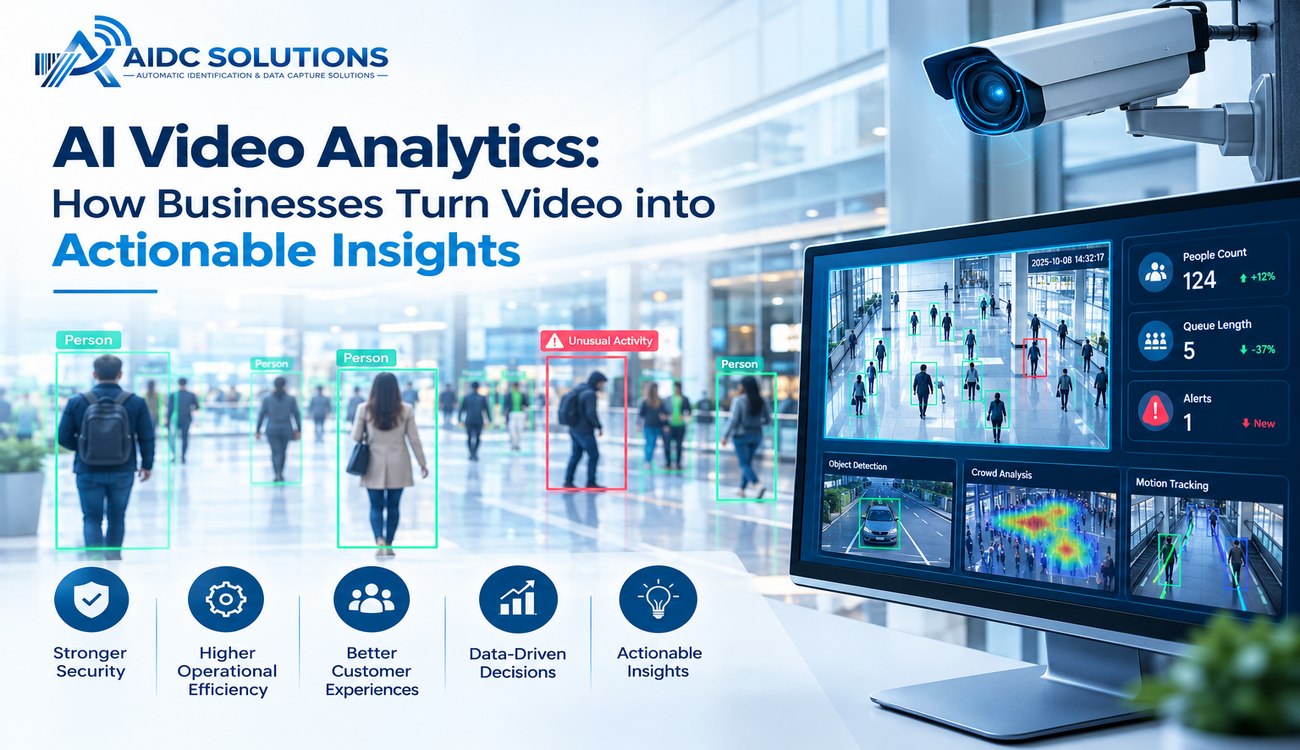
Businesses generate enormous amounts of video data through security cameras, surveillance systems, production monitoring equipment, retail cameras, and other visual technologies. Traditionally, these recordings have been used mainly to monitor activities, investigate incidents, and improve security. However, manually reviewing hours of footage can be time-consuming, and important patterns may remain unnoticed.
Artificial intelligence is changing how organizations use video by enabling systems to identify objects, recognize patterns, detect unusual activities, and generate useful information automatically. Instead of simply recording what happens, businesses can understand what is happening across their operations and respond more effectively.
AI Video Analytics helps organizations transform video footage into actionable insights that support operational efficiency, workplace safety, customer experience, and better decision-making. By combining computer vision, machine learning, and real-time data processing, businesses can identify problems earlier, monitor performance, and make informed decisions based on visual information.
What is AI Video Analytics?
AI video analytics is the use of artificial intelligence and computer vision technologies to analyze video streams and extract meaningful information from visual data. These systems can detect objects, identify movement patterns, count people or vehicles, recognize specific events, and generate alerts when predefined conditions occur.
Traditional video surveillance generally depends on people watching live feeds or reviewing recorded footage after an incident. AI-powered systems automate much of this analysis, allowing teams to monitor multiple camera feeds and focus their attention on situations that require investigation or intervention.
For example, a warehouse can use video analytics to identify congestion in loading areas, while a manufacturer can monitor whether workers enter restricted zones. A retailer may analyze customer movement patterns to understand how visitors interact with different sections of a store.
The technology does not simply collect more footage. Its primary value comes from converting visual information into structured data that organizations can use to improve processes and evaluate performance.
How AI Video Analytics Works
Video Data Collection
The process begins with cameras installed across business environments, such as retail stores, factories, warehouses, offices, parking facilities, and transport hubs. Depending on the use case, organizations may use existing CCTV infrastructure or deploy specialized cameras with suitable resolution and coverage.
The quality of the collected footage influences how accurately an analytics system can identify objects and events. Lighting, camera positioning, obstructions, video resolution, and environmental conditions can all affect performance.
Computer Vision and AI Processing
Once video data is collected, computer vision models analyze individual frames or sequences of frames to identify relevant information. These models may detect people, vehicles, equipment, objects, movement, or specific visual patterns.
Machine learning models can classify activities and recognize events based on their training and configuration. For example, a system may detect a vehicle entering a restricted area or identify when a production line stops moving.
The system’s capabilities depend on the model, available data, operating environment, and business requirements. AI-generated detections should be tested under real conditions because lighting changes, crowded scenes, and unusual situations can lead to inaccurate results.
Insight Generation and Alerts
After analyzing the footage, the platform converts relevant detections into information that employees can use. This may include dashboards, event notifications, traffic counts, safety alerts, occupancy reports, and operational summaries.
When integrated with other business systems, video insights can trigger additional workflows. For example, detecting congestion in a warehouse aisle may notify a supervisor, while identifying a production interruption may create an alert for the operations team.
This process allows businesses to move from passive monitoring toward more proactive operational management.
Key Benefits of AI Video Analytics for Businesses
Improved Operational Efficiency
Businesses often have limited visibility into how people, equipment, and processes move through physical environments. Manual observations may provide only occasional snapshots of daily operations, making it difficult to identify recurring delays or inefficient workflows.
AI video analytics can reveal patterns such as long queues, repeated congestion, idle equipment, and unnecessary movement. Managers can use these findings to adjust staffing, improve layouts, redesign workflows, and reduce avoidable delays.
For example, a distribution center may discover that a particular loading area experiences congestion during specific hours. The organization can use this insight to adjust shift schedules or improve vehicle coordination.
Enhanced Workplace Safety
Workplace accidents can lead to injuries, downtime, and compliance challenges. Monitoring safety conditions manually across large facilities can be difficult, especially when multiple production lines or operational areas require supervision.
Video analytics can detect selected safety-related events, such as people entering restricted zones, vehicles moving through designated pedestrian areas, or workers entering locations where protective equipment is required. The system can alert authorized personnel when a configured condition is detected.
These alerts support safety teams but do not replace physical safeguards, established safety procedures, or human supervision. Businesses should validate detections carefully and ensure that the system supports rather than weakens their existing safety practices.
Better Customer Experience
Retailers, shopping centers, and service businesses can use visual analytics to understand customer movement and identify areas where service improvements may be needed.
For instance, aggregated footfall and queue-length information can help managers identify busy periods, allocate staff, and improve store layouts. Businesses can also compare traffic across different areas to understand whether displays, entrances, or service counters are positioned effectively.
These insights can improve customer convenience without requiring employees to manually count visitors throughout the day. Organizations should prioritize aggregated information and avoid collecting personal data that is unnecessary for the intended purpose.
Faster Incident Detection
Traditional surveillance often requires an operator to notice an incident in real time or review footage after an event has occurred. AI systems can monitor video streams continuously and flag configured events for investigation.
Examples include unauthorized entry, unexpected movement in restricted areas, unattended objects in suitable environments, or vehicles entering prohibited zones. Automated alerts can help security teams prioritize important events instead of watching every camera feed continuously.
Detection is not the same as confirmation, however. Human review remains important when an alert could lead to disciplinary action, security intervention, or another consequential decision.
Data-Driven Decision-Making
Video can reveal operational details that may not appear in conventional business reports. When analyzed consistently, visual data can help organizations understand how their facilities are used, when bottlenecks occur, and where procedures may need improvement.
AI Video Analytics enables managers to combine these insights with information from inventory systems, production platforms, customer service tools, and other business applications. This broader view helps decision-makers connect physical activity with measurable operational outcomes.
Major Use Cases of AI Video Analytics
Retail and Shopping Centers
Retail businesses can use video analytics for people counting, queue monitoring, store traffic analysis, and operational planning. Managers can identify peak shopping periods, compare customer movement across store sections, and determine where additional staff may be required.
These insights can support better staffing decisions and store layout improvements. Where customer behavior is analyzed, businesses should use appropriate privacy safeguards and avoid making sensitive personal inferences without a valid legal basis.
Manufacturing and Industrial Facilities
Manufacturers can use video analytics to monitor production processes, detect selected quality issues, and identify operational interruptions. Computer vision systems can inspect visible product characteristics, such as surface defects, missing components, or incorrect assembly, when suitable cameras and models are available.
Video-based monitoring can also help identify repeated workflow bottlenecks and unsafe movement around machinery. When integrated with manufacturing systems, visual detections can provide additional context for investigating production delays or quality problems.
Warehousing and Logistics
Warehouses depend on coordinated movement between workers, forklifts, pallets, loading docks, and storage areas. Congestion or unsafe movement can affect throughput and increase operational risks.
Video analytics can monitor traffic patterns, identify blocked aisles, measure loading activity, and detect selected safety events. Logistics teams can use the resulting information to improve space utilization, coordinate activities, and reduce delays across warehouse operations.
Smart Buildings and Office Facilities
Office buildings and commercial facilities can use video analytics to understand occupancy patterns, monitor access areas, and improve the management of shared spaces. Aggregated occupancy information may help facilities teams optimize room usage, manage visitor flow, and plan cleaning or maintenance schedules.
Where analytics are connected to building management systems, occupancy trends can also support decisions about lighting, ventilation, and energy use, subject to the capabilities of the integrated systems.
Transportation and Parking Management
Transport operators can use visual analytics to count vehicles, estimate traffic flow, monitor parking occupancy, and identify congestion. These insights help facility managers improve traffic coordination and use available parking spaces more effectively.
At transport facilities, analytics may also support the detection of selected incidents or unauthorized vehicle movements. Deployments should account for weather, changing light conditions, camera coverage, and the need for human verification.
Best Practices for Implementing AI Video Analytics
Define Clear Business Objectives
Businesses should begin by identifying the problem they want to solve rather than installing AI simply because the technology is available. Objectives may include reducing queue times, improving safety compliance, detecting product defects, or understanding facility utilization.
Each objective should have a measurable indicator, such as average waiting time, number of verified safety incidents, defect detection rate, or vehicle turnaround time. Establishing a baseline makes it easier to determine whether the system delivers practical value.
Assess Existing Camera Infrastructure
Before purchasing new equipment, organizations should evaluate whether existing cameras can support the intended analytics use case. Factors such as image quality, viewing angles, frame rate, lighting, and network capacity influence the system’s performance.
Some applications may work with existing CCTV cameras, while detailed inspection or precise detection may require specialized equipment. A site assessment helps determine the most appropriate approach.
Choose the Right AI Models and Platform
Different applications require different models and processing capabilities. People counting, object detection, visual quality inspection, and movement analysis are distinct tasks and should be evaluated separately.
Businesses should test model performance using representative footage from their own environments. They should also consider integration capabilities, scalability, system reliability, support requirements, and the costs of maintaining models over time.
Integrate Insights with Business Workflows
Video analytics is more valuable when its outputs lead to appropriate action. Connecting insights with existing operational systems can help route alerts, record incidents, notify supervisors, and support follow-up activities.
Integration should be designed carefully to avoid overwhelming staff with notifications. Clear alert thresholds, defined responsibilities, and escalation procedures help ensure that important events receive timely attention.
Prioritize Privacy and Cybersecurity
Video footage may contain identifiable individuals, sensitive business activities, or information about restricted areas. Organizations should establish clear rules for collecting, processing, storing, and accessing video data.
Privacy safeguards may include limiting camera coverage to necessary areas, restricting access to authorized personnel, applying retention schedules, and using anonymization or aggregation where appropriate. Businesses should also protect camera networks, secure stored footage, maintain software updates, and comply with applicable privacy and surveillance laws.
Challenges and Limitations to Consider
AI video analytics can produce inaccurate detections when footage is poor, camera views are obstructed, or operating conditions differ from those represented in model training data. Organizations should test performance across different shifts, lighting conditions, crowd levels, and relevant scenarios before relying on automated alerts.
Infrastructure and integration costs can also become significant when a deployment involves many cameras, high-resolution streams, or extensive storage. Edge processing can reduce the need to transmit all footage to a central server, while cloud processing may offer flexibility for some workloads. The right approach depends on latency, bandwidth, privacy, and cost requirements.
Another challenge is employee trust. Workers may be concerned about surveillance or how performance information is used. Transparent communication, clear policies, limited data collection, and appropriate human oversight can help ensure that the system is used responsibly.
Measuring the ROI of AI Video Analytics
Organizations should evaluate results using metrics directly connected to their business objectives. Retailers may measure queue duration and staffing efficiency, manufacturers may monitor defect rates and downtime, and logistics companies may assess loading times and warehouse congestion.
Security and safety teams can review verified incident response times, false-alert rates, and the time required to investigate events. These measures help distinguish useful detections from alerts that create additional work.
A complete return-on-investment calculation should also include cameras, computing infrastructure, software licenses, integration, storage, maintenance, and employee training. Comparing these costs with measurable improvements provides a more realistic picture of long-term value.
The Future of AI Video Analytics
Advances in computer vision, edge AI, and multimodal AI are making video analysis more adaptable to complex business environments. Future systems are likely to combine visual information with data from sensors, operational software, and other sources to provide richer context.
For example, a manufacturer could combine video-based production monitoring with machine sensor data to investigate recurring interruptions. A logistics facility could connect vehicle movement insights with loading schedules to improve coordination.
As these systems become more capable, organizations will need to maintain clear controls over accuracy, privacy, access, and automated actions. Human review should remain central whenever the consequences of an incorrect detection could be significant.
Conclusion
Video is becoming more than a security resource for modern organizations. When analyzed using artificial intelligence, it can provide valuable information about safety, operational performance, customer movement, equipment activity, and facility utilization.
AI Video Analytics helps businesses turn visual information into measurable insights that support faster responses and more informed decisions. Successful implementation depends on clear objectives, suitable infrastructure, reliable models, integration with existing workflows, and responsible data governance.
Frequently Asked Questions
Q1. What is AI Video Analytics?
AI Video Analytics uses artificial intelligence and computer vision to analyze video footage and identify meaningful patterns, objects, movements, and events. Businesses use it to improve security, monitor operations, detect safety risks, and generate insights that support better decision-making.
Q2. What are the main benefits of AI Video Analytics for businesses?
The main benefits include improved operational efficiency, faster incident detection, enhanced workplace safety, better customer experiences, and data-driven decision-making. It also helps businesses identify bottlenecks, monitor performance, and reduce the time required for manual video review.
Q3. Which industries can benefit from AI Video Analytics?
Retail, manufacturing, logistics, healthcare, transportation, and commercial real estate can benefit from AI Video Analytics. These industries use the technology for people counting, quality inspection, traffic monitoring, safety alerts, equipment monitoring, and facility optimization.
Q4. How does AI Video Analytics turn video into actionable insights?
AI Video Analytics uses computer vision and machine learning models to detect objects, recognize movement patterns, and identify specific events in video streams. It converts these detections into dashboards, reports, and alerts that help businesses identify problems and take appropriate action.
Q5. How can businesses implement AI Video Analytics successfully?
Businesses should define clear objectives, assess existing camera infrastructure, select suitable AI models, and integrate analytics with operational systems. They should also test accuracy, train employees, establish privacy and security controls, and measure results using relevant performance indicators before expanding the deployment.