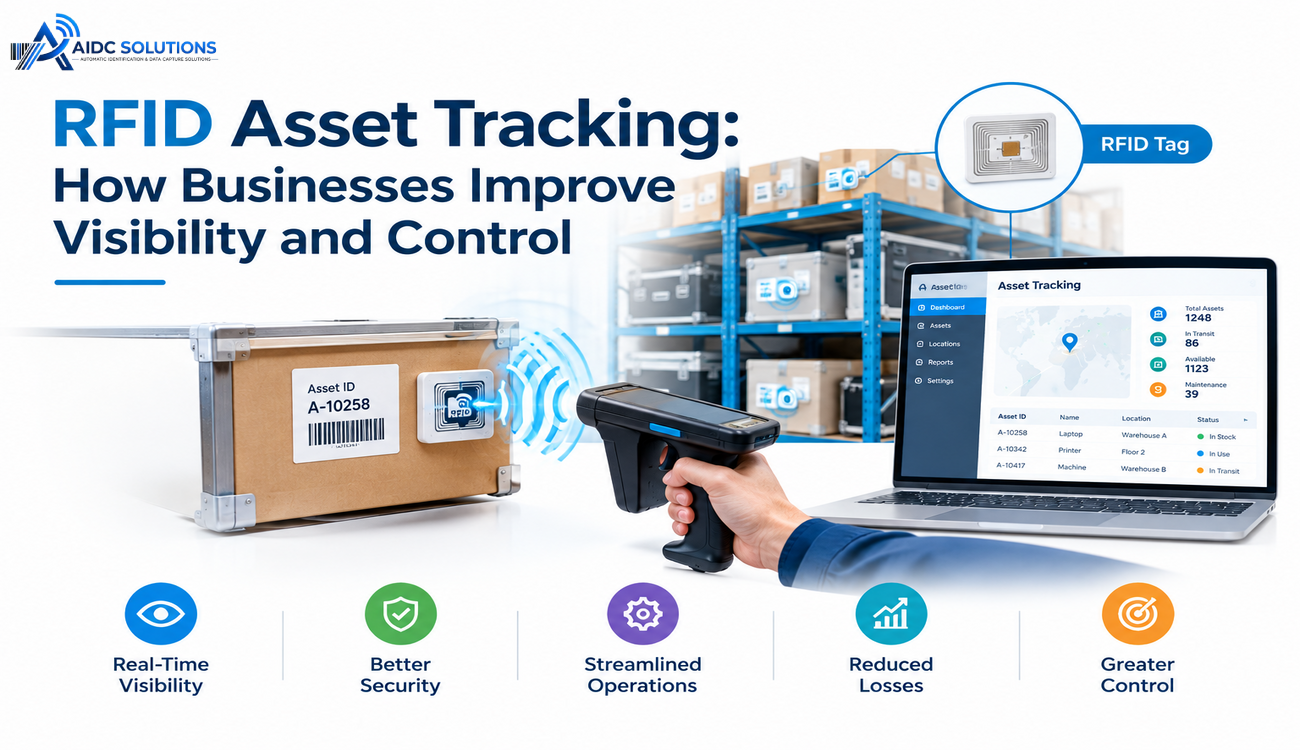
Businesses today manage increasingly complex inventories, equipment, tools, products, and operational assets across warehouses, offices, manufacturing facilities, healthcare environments, retail locations, and distribution centers. As the number of assets grows, maintaining accurate information about where items are, how they move, and whether they are available becomes increasingly difficult. Manual tracking methods and barcode-based processes can provide basic identification, but they often require considerable human effort and do not always deliver real-time visibility. RFID Asset Tracking offers a more connected approach to managing physical assets. By using radio frequency identification technology, businesses can automatically identify and monitor tagged items as they move through operational environments.
This enables organizations to reduce manual tracking, improve inventory accuracy, strengthen asset control, and make faster decisions based on more reliable information.
What is RFID Asset Tracking?
RFID Asset Tracking is a technology-driven method for identifying, monitoring, and managing physical assets using RFID tags, readers, antennas, and tracking software. An RFID tag attached to an asset stores identifying information that can be captured by an RFID reader through radio waves. Unlike traditional barcode systems, RFID does not always require direct line-of-sight scanning, allowing organizations to identify multiple tagged items within a reading area.
The information collected by RFID readers can be transferred to centralized software platforms where businesses can monitor asset locations, movement, status, and usage. This creates a digital connection between physical assets and operational systems, helping organizations understand what they have, where it is, and how it is being used.
How RFID Technology Works
An RFID system generally consists of a tag attached to an asset, an RFID reader that captures tag information, antennas that facilitate communication, and software that processes the collected data. When a tagged item enters the reader’s range, the system can capture its unique identifier and send the information to a connected application.
Depending on the implementation, RFID technology can support fixed monitoring points, handheld scanning, automated gates, smart shelves, cabinets, and other infrastructure. This flexibility allows businesses to design tracking environments around their operational requirements instead of relying on a single tracking method.
RFID Tags and Asset Identification
RFID tags are available in different formats and can be selected according to the environment in which assets are used. Tags can be attached to equipment, containers, tools, inventory, documents, returnable assets, or other physical items.
Businesses can associate each tag with information stored in an asset management platform. This creates a digital identity for physical assets and makes it easier to maintain consistent records throughout their operational lifecycle.
Why Businesses Need Better Asset Visibility
Asset visibility has become an important operational priority because organizations cannot effectively control what they cannot accurately locate or monitor. When asset information is maintained through spreadsheets, paperwork, or disconnected systems, employees may spend significant time searching for equipment, verifying inventory, or updating records.
Poor visibility can also result in misplaced assets, unnecessary purchases, delayed operations, equipment underutilization, and inaccurate inventory records. These issues become more significant when assets move between departments, facilities, warehouses, or customer locations.
RFID Asset Tracking helps address these challenges by creating automated identification points throughout the asset lifecycle. Instead of relying entirely on employees to record every movement, organizations can capture asset events electronically and connect them with centralized systems.
Reducing Manual Tracking
Manual asset tracking requires employees to scan, record, verify, and update information regularly. Even when processes are carefully designed, human errors can result in missing records or outdated information.
RFID automation reduces the amount of manual data entry required during asset movement and inventory processes. Employees can focus more on operational activities while the technology captures identification events in the background.
Improving Inventory Accuracy
Accurate inventory information is essential for purchasing, production planning, warehouse management, maintenance, and customer fulfillment. When records do not reflect the actual physical inventory, businesses may make decisions based on incomplete information.
RFID enables faster identification of tagged assets and can support more frequent inventory checks. This allows organizations to compare digital records with physical assets more efficiently and identify discrepancies earlier.
How RFID Improves Control Over Business Assets
Visibility is only one part of effective asset management. Businesses also need control mechanisms that help them understand how assets are being used, where they are moving, and whether they are available when required.
RFID Asset Tracking provides organizations with structured data that can support better control over physical resources. When asset movement is recorded automatically, managers can identify unusual activity, investigate missing items, and improve accountability across departments.
Monitoring Asset Movement
RFID readers can be positioned at important locations such as warehouse entrances, production areas, storage zones, loading docks, or facility access points. When tagged assets pass through these areas, the system can capture their movement.
This creates a digital history that can help organizations understand how assets move through different stages of operations. Such information can be particularly useful for high-value equipment, reusable containers, tools, and inventory that frequently moves between locations.
Preventing Loss and Misplacement
Lost or misplaced assets can create direct financial costs as well as operational delays. Employees may spend hours searching for equipment that has been moved without proper documentation.
With RFID-enabled monitoring, organizations can establish greater accountability around asset movement. If an item moves through a monitored area, the system can record the event and provide useful information for locating it or understanding its last known movement.
Applications Across Different Industries
The flexibility of RFID technology makes it suitable for a wide range of business environments. Organizations can adapt RFID systems to different asset types, operational processes, and tracking requirements.
Manufacturing
Manufacturers can use RFID to monitor tools, components, work-in-progress materials, finished goods, and reusable containers. Tracking these assets can help improve production visibility and reduce delays caused by missing materials or equipment.
RFID data can also support better coordination between production stages by providing information about where materials and assets are located within a facility.
Warehousing and Logistics
Warehouses handle large volumes of products and assets that continuously move through receiving, storage, picking, packing, and dispatch operations. RFID can automate identification at important points in these workflows.
By reducing manual scanning requirements, businesses can accelerate inventory activities while improving the reliability of asset movement records. Logistics companies can also use RFID to monitor reusable transport items and containers throughout distribution networks.
Healthcare
Hospitals and healthcare organizations manage medical equipment, devices, supplies, and other valuable assets across multiple departments. Finding equipment quickly can directly affect operational efficiency.
RFID can help healthcare organizations identify equipment locations, monitor movement, and improve utilization. Staff can spend less time searching for devices and more time focusing on patient and operational responsibilities.
Retail
Retailers can use RFID to improve inventory visibility across stores, warehouses, and distribution centers. More accurate information about product availability can support replenishment, reduce stock discrepancies, and improve customer service.
RFID can also help businesses understand product movement from inventory areas to sales floors, creating better visibility across retail operations.
Integrating RFID With Business Systems
The effectiveness of an RFID implementation increases when tracking information is connected with existing enterprise systems. Rather than operating as an isolated technology, RFID can exchange information with inventory management platforms, ERP systems, warehouse management systems, asset management applications, and analytics platforms.
This integration allows organizations to connect physical asset events with business processes. For example, an RFID event indicating that equipment has moved into a maintenance area could trigger an update in an asset management system.
Creating a Centralized Asset View
A centralized platform can bring RFID-generated information together with existing asset records. Managers can then access a more complete view of asset identity, location, status, and movement.
This approach reduces dependence on disconnected spreadsheets and makes asset information easier to access across departments. It also creates a stronger foundation for reporting and operational analysis.
Using Data for Better Decisions
The data generated through RFID systems can reveal patterns that are difficult to identify through manual tracking. Businesses can analyze asset utilization, movement frequency, idle periods, and operational bottlenecks.
These insights can help organizations determine whether assets are being fully utilized or whether additional resources are genuinely required. Over time, data-driven decisions can contribute to better resource planning and cost management.
Key Considerations Before Implementing RFID
Successful RFID implementation requires more than installing readers and attaching tags. Businesses need to understand their workflows, asset characteristics, facility conditions, and tracking objectives before selecting technology.
Different materials and environments can affect RFID performance, so organizations should evaluate tag types, reader placement, antenna configuration, software requirements, and integration needs carefully.
Defining Clear Tracking Objectives
The first step is understanding what the organization wants to improve. Some businesses may prioritize inventory accuracy, while others may focus on preventing asset loss, improving equipment utilization, or monitoring movement between facilities.
A clearly defined objective makes it easier to design an RFID solution that addresses actual operational problems rather than introducing technology without a measurable purpose.
Planning for Scalability
An RFID system should be capable of expanding as the organization grows. Businesses may initially deploy the technology in one warehouse, department, or facility before extending it across multiple locations.
A scalable architecture makes it easier to add more tagged assets, readers, users, and integrations without rebuilding the entire tracking environment.
The Future of RFID-Based Asset Management
RFID is increasingly becoming part of broader connected asset management strategies. As businesses combine RFID with IoT platforms, cloud systems, analytics, artificial intelligence, and enterprise applications, asset tracking can evolve from simple identification into intelligent operational management.
Future solutions are likely to provide deeper insights into asset utilization, movement patterns, maintenance requirements, and operational performance. Organizations will increasingly use connected asset data not only to locate physical resources but also to predict requirements and optimize workflows.
Conclusion
Modern businesses need accurate and timely information about physical resources to maintain operational efficiency and control costs. Traditional tracking approaches can struggle to provide the speed, accuracy, and visibility required across complex environments.
RFID Asset Tracking gives organizations a practical way to connect physical assets with digital systems and automate important identification and movement processes. From manufacturing and logistics to healthcare and retail, the technology can reduce manual effort, improve inventory accuracy, strengthen asset accountability, and provide valuable operational insights.
The greatest value comes when RFID is integrated into broader business workflows rather than treated as a standalone tracking solution. With the right implementation strategy, businesses can transform asset information into actionable intelligence, improve resource utilization, and build more transparent and controlled operations.
Frequently Asked Questions
Q1. What is RFID Asset Tracking?
RFID Asset Tracking is a technology-based approach for identifying, monitoring, and managing physical assets using RFID tags, readers, antennas, and software. It helps businesses automatically capture asset movement and location information, improving visibility, accuracy, and control.
Q2. How does RFID improve asset visibility?
RFID improves asset visibility by automatically identifying tagged items when they pass through RFID reader zones. Businesses can use the collected information to understand where assets are located, how they move between areas, and whether they are available when needed.
Q3. What types of assets can be tracked using RFID?
RFID can be used to track equipment, tools, inventory, containers, medical devices, products, documents, and other physical resources. The appropriate RFID tag depends on the asset material, operating environment, required reading distance, and tracking process.
Q4. Can RFID integrate with ERP and inventory management systems?
Yes, RFID solutions can integrate with ERP, warehouse management, inventory management, asset management, and other enterprise systems. This allows RFID-generated asset information to become part of existing business workflows and centralized reporting platforms.
Q5. What are the main benefits of using RFID for asset management?
RFID can help businesses improve inventory accuracy, reduce manual data entry, minimize misplaced assets, monitor asset movement, improve resource utilization, and gain better operational visibility. These benefits can support stronger asset control and more informed business decisions.